ART JOURNAL PROMPTS FOR JOURNALING & CREATIVITY

What is an art journal?

An art journal is a visual diary; it combines elements of writing, drawing, painting, collage, and even printmaking to express yourself. This includes your everyday life, as well as your bigger hopes, dreams, and fears. A single page will often fuse words and illustrations to offer a look at what’s going on inside your head.

There are many considerations when it comes to picking your journal. Size is one. If you enjoy making large drawings, for instance, then a bigger book might be best. Art journals look great when you fill the page, so whatever the size you choose, make sure it complements the way you like to work

Here’s a couple of ideas for how you can use prompts to spark your journal pages:

  • Use them as a list for things to draw or sketch
  • Use the prompts to find fitting quotes that you like
  • Write about your thoughts and feelings related to the prompt in hidden journaling as a background layer.
  • Use colors and textures that fit the theme, mood, and feeling of a word

THESE SUPPLIES ARE A GREAT FOR ART JOURNALING:

  • Watercolor paints or watercolor pencils
  • Acrylic paint
  • Colored pencils
  • A variety of pens, from fine-tipped to thick brushes
  • White ink
  • Glue sticks (for collage)
  • Old magazines, newspaper, or other interesting papers

TRY THESE 10 ART JOURNAL IDEAS!

Creating an art journal is all about you, but sometimes you need some help to get started.

  • Introduce yourself! Draw or paint a self portrait.
  • Draw some of the items you bought recently.
  • Create a map of you favorite place, real or imagined.
  • Draw a favorite childhood memory.
  • Go for a nature walk and collect flowers or leaves. Write about your walk and why you gathered these items.
  • Paste old photos and doodle on top of them using marker.
  • Fill a page with geometric shapes.
  • Illustrate what’s in your bag.
  • Draw your favorite pet.
  • Hand letter an inspiring quote or personal mantra.


To help you get started, here is a list of 365 one word journal prompts to jump start your creativity. You can either pick any word that fits your creative mood, or you can go day by day down the list.

1. Happiness: What makes you happy? What brings you the most joy possible?

2. Beauty: How do you define beauty? What things are beautiful to you?

3. Sleep: What things help you sleep at night? Or, are you a night owl? Do you get enough sleep or wish you could sleep more?

4. Garden: From flowers to plants to paths, there is much to be inspired by in the garden!

5. Imagination: How do you interpret the word imagination? Where might your imagination lead you?

6. Secret: Secrets can be very hard to keep!

7. Give: Think about what it means to be giving, or of someone who has given you something special or an opportunity.

8. Thankful: A little gratitude in your journal can always go a long way!

9. Kindness: From random acts of kindness to ways you can be kind to others.

10. Inside: Inside can be anywhere – inside your heart, your mind, your closet, your purse… 🙂

11. Outside: Outside can also be far reaching – from outside the window or how others view us on the outside.

12. Jump: Are you ready to dive into something new? Thinking about taking a leap?

13. Friendship: Do you have friends who are special to you? Create a page that is an ode to a special friend {and yes, furry friends totally count!}

14. Love: What does love mean to you? What things in life do you love most? The best thing about these art journal prompts is how you interpret them is totally up to you!

15. Fire: From a gentle candle flame to a roaring fire – use this element as inspiration.

16. Believe: What do you believe in? Maybe it’s magic or a cause that you are passionate about.

17. Hope: There is always hope! What things are you hopeful about?

18. Faith: What do you have faith in?

19. Focus: Do you find it easy to focus? Or perhaps think focus as a camera lens – do you zoom in or zoom out?

20. Clean: What does clean mean to you? Soap and bubbles, laundry or housework or something else?

21. Angry: Art journals are great places to express anger!

22. Work: What type of work do you enjoy? OR…you could always create pages based on different professions, such as construction workers or business people or secretaries.

23. Music: What are you listening to today? 24. Stars: Do the stars align? What do you think when you see the stars? Or you of course can create a page about outer space and space aliens and astronauts!

25. Mystery: Is there an unsolved mystery? What do you think of that evokes a sense of mysteriousness in a person or mood?

26. Envelope: Use an envelope in your page, or doodle and draw on an envelope and send to a friend. Or, maybe create a page all about the expression, “Pushing the Envelope”.

27. Book: Have you read any good books lately?

28. Dare: I dare you!

29. Choose: Making decisions is NOT always so easy!

30. Beach: Which way to the beach? What are your favorite things? Is there a scene that pops into your mind when you think of the beach?

31. Forgiveness: Saying I’m sorry

32. Disaster: Oh no

33. Dance: You can dance if you want to! Ballerinas, line dancing, square dancing, the waltz, the polka…

34. Mistake: Making mistakes in art journaling can be part of the fun!

35. New: New people, new places, new things

36. Yes: Say yes! What is something you have said yes to recently?

37. Path: What pathways do you think of? Brick? Stone? Gravel? Dirt? The woods? The beach? A meadow?

38. Horizon: Sunrise, sunset – what’s on the horizon?

39. Mountain: Scenic views or a metaphor for challenges in life

40. River: Let it flow

41. Open: What’s opening? Maybe your eyes, or a door, or a box…hmmm…

42. Heart: What fills your heart – or just draw and doodle your favorite heart patterns and designs!

43. Soul: What is the core of your very being?

44. Tear: Torn paper or tears rolling down your cheeks?

45. Spiral: Around the spiral staircase we go! Or, for even more fun, pull out the spirograph!

46. Up: Draw arrows or ladders

47. Go: The places we go!

48. Be: Mindfulness and being

49. Seek: What do you seek in life?

50. Learn: Something you want to learn or a lesson you’ve learned, or maybe even some back to school type of theme.

51. Balance: This art journal prompt could be about balancing things in your life, or even balancing contrasting colors on a page.

52. Grow: How have you grown? What things are growing in your life?

53. Strength: Superman’s got nothing on you. 🙂

54. Dream: Whether a dream you want to achieve or a page inspired by that strange dream you had the other night.

55. Passion: What motivates and excites you?

56. Move: Exercising or moving boxes?

57. Today: Today is today! What are we doing today?

58. Awaken: Are you awakening to something new in your life? Have you had an “alarm clock moment”?

59. Angels: Heavenly inspiration!

60. Laughter: Funny jokes, riddles, comic books – what makes you laugh?

61. Listening: Do you hear what I hear?

62. Pause: Wait a minute!

63. Peace: Peace and Calming

64. Relax: Ways to kick back and chill

65. Space: Draw in 3d space or think about your space around you…or maybe even Outer Space. 🙂

66. Wisdom: wise mind & wise heart

67. Difference: Opposites

68. Begin: Where shall we start?

69. Time: Do you have the time? What time is it? How do you keep track of time?

70. Brave: Courage!

71. Breathe: Deep breath in, deep breath out.

72. Childhood: Memories or childhood innocence and playfulness

73. Discovery: What have you discovered while exploring?

74. Mind: What’s on your mind?

75. Energy: Feeling electric!

76. Flower: Do you have a favorite flower?

77. Health: What makes you feel well?

78. Harmony: Peace and Tranquility – or maybe some harmonious music?A page inspired by the Song “Slow Down” by the Autumn Film

79. Recovery: Recovery comes in all types of different ways – from recovery from an event, an illness or even recovering lost files from a hard drive.

80. Stand: Perhaps an ode to chairs, or maybe inspiration from a time you took a stand on something.

81. Nowhere: Where shall we go?

82. Soar: Birds, hopes, and aspirations.

82. Skip: Next, please!

83. Fresh: Maybe it’s fresh laundry, fresh bread, fresh food growing in a garden or a fresh start in something.

84. Delicious: Who’s hungry?

85. Power: Unplugged or Supercharged?

86. Complete: What completes you? Or, what have you recently completed?

87. Grace: Like a swan?

88. Legend: It’s legendary.

89. Ecstasy: Extreme joy, or maybe a throwback to the 90’s raves…hmmm…

90. Hug: You can never have enough hugs in this world. {Side note, have you ever watched one of my favorite videos “Free Hugs Campaign“?

91. Proud: What makes you feel proud?

92. Simple: Keep it simple!

93. Machine: Beautiful flying machines, time machines, or maybe modern machines that just make our life easier.

MUSIC ART JOURNAL

I love music and must have it on all the time – if I don’t hear music playing I start to hum or sing…lol…it also makes for a great theme for art journals.

Here are some ideas:

  • Musical instrument cut-outs
  • Music quotes
  • Song Lyrics
  • Playlists
  • A page dedicated to a favorite song or two
  • Sheet music for backgrounds or layering
  • Music Lover Prompts

DREAM JOURNAL

Do you keep track of your dreams each night? It can be interesting to do, and you can really learn a lot about yourself and the challenges your subconscious is working through. I do a LOT of dream journeying work, so almost always have a dream journal going at any given time!

In my dream journal I keep mostly quick descriptions of the dreams, but I also write down what I think they may mean – and of course make it pretty with lots of drawings, doodles, and color

LOVE & ROMANCE JOURNAL

This would make for a great gift for your partner – create a journal full of things you love about them, special memories you’ve shared together, photographs, love quotes and sayings, date night ideas, etc. etc. Don’t forget the hearts!

Single? That’s okay, how about creating a self-love journal?

Art Therapy Techniques For De-Stressing this month

Art therapy is a form of therapy predicated on the belief that artistic expression has the power to help us in healing, in self-esteem or simply in chilling out. It’s unique in that most other forms of therapy rely on language as the foremost mode of communication, whereas art requires something different, something harder to define.

Create a Zentangle-inspired creation

Maria Thomas and Rick Roberts‘ Zentangles: A Worldwide Phenomenon. Maria Thomas and Rick Roberts, the inventors of Zentangle. Just nine short years ago, a new and unique art form was created right here in Central Massachusetts.

.

Use a piece of paper, cut into a 3.5-inch square piece, and draw a freehand border around the edge in light pencil. Then use your pencil to draw a curved line or squiggle within the border, called a “string.”

Now switch to a pen and begin drawing a “tangle,” a series of patterns and shapes around your “string” and voila! You got yourself a Zentangle. The process is designed to encourage deliberate, ritual creation and allow room for human error — no erasing, that’s against the rules. Traditional Zentangles are always black and white but we fully support experimenting with color. The entire process shouldn’t take more than 15 minutes, and can be repeated whenever you feel the urge. Keep some squares handy so you can always create when inspiration strikes.

Write a found poem

Don’t consider yourself a poet? Let someone else do the hard part of coming up with the words by grabbing your material from old books, magazines, newspapers or even letters. Cut out words that jump out at or inspire you. Collage your found materials just as you would a visual collage. You can have a topic or story in mind at the beginning, or just get started and see where your word collaging takes you.

Make a forgiveness box

If there is a certain person — including yourself — you don’t want to harbor negative emotions toward any longer, try making him or her a forgiveness box. Decorate a small box with soothing images and words that can be either specific to an individual or catered to your desired inner state. You can write the person’s name on a slip of paper and include it in the box if preferred, and the name can be removed and exchanged if needed. The act of making the box will bring up happy memories of whomever the box is for, as well as help you physically work toward a place of forgiveness.

Turn a journal entry into a work of art

Whether you’re drawing inspiration from last week’s misadventure or your third grade trials and tribulations, why not creative a visual adaptation of your own first-person narration? Take an old journal entry — one that was especially poignant, difficult, joyous, or totally arbitrary — and recreate the text as imagery. Feel free to draw, paint, collage, whatever can best express the atmosphere of that one day.

Bring a motivational message to a colorful life.

Do you have a phrase or saying that makes you feel uplifted?  Cut the words out of magazines and arrange an encouraging display. Don’t have a “go to” phrase? Find generic words, such as “happy,” “joy,” “inspire,” and start with a general display of words. Crack open old journals for inspiration, or start a new art journal for your new creations

Help something grow.

Gardening is an art form that employs plants as paint and your hands as tools. Whether you build your garden in a small tabletop bowl, or take over an entire hillside for your colorful creation, let your imagination soar. Don’t know much about plants? Spend some time at a local nursery and find out what grows best in your area, and what care requirements are realistic for you.

How to Relieve Stress With Art Therapy


  • Sketch pictures that describe your feelings related to things in your life that are causing you stress currently. If it’s in the back of your mind anyway, this could be a way of processing your related emotions, reducing some of the stress they carry.
  • Distraction: Drawing and art can take your mind off of what’s stressing you, at least for a few minutes. It’s difficult to keep ruminating on your problems when you’re focused on creating, and if your problems stay with you, you can incorporate them into your creations. And when you’re finished being engrossed in your sketches, you should have a clearer head with which to tackle your problems again.
  • Self-Care: Just the act of having a hobby can make you feel more balanced in your lifestyle. Sometimes, with all of life’s responsibilities, we forget that we need and deserve ‘down time’ and self-care. Taking even a few minutes on a regular basis to devote to a hobby can give you more of what you need in this area. And, with drawing, you have the additional benefit of being left with something beautiful (or at least interesting) to show for it.

Art Project Ideas for Stress Relief

A great way to use the act of drawing for stress relief is to maintain a sketch diary. Keeping a sketchbook can be a form of journaling, and it can be cathartic, creative, and stress relieving. You can use a journal for personal art therapy and stress management in the following ways:

  • Sketch pictures that describe your feelings related to things in your life that are causing you stress currently. If it’s in the back of your mind anyway, this could be a way of processing your related emotions, reducing some of the stress they carry.
  • Sketch abstract pictures that express feelings related to past stressful experiences, as a way of processing your emotions and healing. This can be a form of journaling but can be especially helpful for those who are more comfortable with ideas and emotions that don’t need to be put into words.
  • Keep a “Dream Sketch Diary”, and sketch scenes from dreams you’d like to remember or better understand. You can also keep a “Gratitude Sketch Diary” to catalog what you’re grateful for in your life. There are several different types of sketch diaries you can create and enjoy.
  • Keep a sketch diary of what you think is beautiful in life. Draw the faces of those you love, places that bring you peace, or other pieces of beauty. The process of sketching can be a great stress reliever, and revisiting your creations can also bring you some peace in the future.
  • Start enjoying some of the adult coloring books that have become popular—they can be especially relaxing for those who don’t feel artistic but want to create easy, beautiful, and stress-free pictures.

How Art helps people with mental health

Art – no matter whether you choose to create it yourself or simply observe and enjoy it – is a relaxing and inspiring activity for many people. Studies suggest that art therapy can be very valuable in treating issues such as depression, anxiety, post-traumatic stress disorder and even some phobias. It is a great way to express your emotions without words, process complex feelings and find relief.

Art therapy improves the mental health of people who are dealing with addictions, anxiety, attention disorders, grief and loss, dementia, depression, eating disorders, physical illness, PTSD, trauma, relationship issues and much more.

Some of their findings show art therapy:

  • Helped reduce pain, decrease symptoms of stress and improve quality of life in adult cancer patients.
  • Improved ability to deal with pain and other frightening symptoms in children with cancer.
  • Reduced stress and anxiety in children with asthma.
  • Stimulated mental function in older adults with dementia.
  • Indicated a reduction in depression in Parkinson’s patients.
  • Children or adults who have experienced a traumatic event


https://www.youtube.com/watch?v=F2kwo6UFRM8

Mental Health Benefits of Art Therapy Activities

Art therapy can be used as a complement to traditional mental health treatment.  The aim is to manage behaviors, process feelings, reduce stress and anxiety, and increase self-esteem.

  • Self-discovery: Creating art can help you acknowledge and recognize feelings that have been lurking in your subconscious.
  • Self-esteem: The process will give you a feeling of self-accomplishment which can be very valuable to improve your self-appreciation and confidence.
  • Emotional release: The greatest benefit of art therapy is giving you a healthy outlet for expressing and letting go all your feelings and fears. Complex emotions such as sadness or anger sometimes cannot be expressed with words. When you are unable to express yourself, but you desire emotional release, making art may help you to do it.
  • Stress relief: Fighting anxiety, depression or emotional trauma can be very stressful for you both mentally and physically. Creating art can be used to relieve stress and relax your mind and body.

Art Therapy Exercises –

Emotions

Deal with emotions like anger and sadness through these helpful exercises.

  1. Draw or paint your emotions. In this exercise, you’ll focus entirely on painting what you’re feeling.
  2. Create an emotion wheel. Using color, this activity will have you thinking critically about your emotions.
  3. Make a meditative painting. Looking for a creative way to relax?  Have trouble sitting still to meditate?  Meditative painting might be just the thing you’re looking for.  No painting skill or experience necessary – only a desire to relax and become more creative.
  4. Put together a journal. Journals don’t have to just be based around words. You can make an art journal as well, that lets you visually express your emotions.
  5. Explore puppet therapy. Puppets aren’t just for kids. Make your own and have them act out scenes that make you upset.
  6. Use line art. Line is one of the simplest and most basic aspects of art, but it can also contain a lot of emotion. Use simple line art to demonstrate visually how you’re feeling.
  7. Design a postcard you will never send. Are you still angry or upset with someone in your life? Create a postcard that expresses this, though you don’t have to ever send it.
  8. Create a family sculpture. For this activity, you makes a clay representation of each family member– mother, father, siblings, and any other close or influential family members to explore emotional dynamics and roles within your family.
  9. Paint a mountain and a valley. The mountain can represent a time where you were happy, the valley, when you were sad. Add elements that reflect specific events as well.
  10. Attach a drawing or message to a balloon. Send away negative emotions or spread positive ones by attaching a note or drawing to a balloon and setting it free.
  11. Draw Your Heart. Draw your feelings in a heart formation.Relaxation

    Art therapy can be a great way to relax. Consider these exercises if you’re looking to feel a little more laid back.

    1. Paint to music. Letting your creativity flow in response to music is a great way to let out feelings and just relax.
    2. Make a scribble drawing. With this activity, you’ll turn a simple scribble into something beautiful, using line, color and your creativity.
    3. Finger paint. Finger painting isn’t just fun for kids– adults can enjoy it as well. Get your hands messy and really have fun spreading the paint around.
    4. Make a mandala. Whether you use the traditional sand or draw one on your own, this meditative symbol can easily help you to loosen up.
    5. Draw with your eyes closed. Not being able to see what you are drawing intensifies fluidity, intuition, touch and sensitivity.
    6. Draw something HUGE. Getting your body involved and moving around can help release emotion as you’re drawing.
    7. Use color blocks. Colors often come with a lot of emotions attached. Choose several paint chips to work with and collage, paint and glue until you’ve created a colorful masterpiece.
    8. Let yourself be free. Don’t allow yourself to judge your work. If you think your paintings are too tight and controlled, this collection of tips and techniques to try should help you work in a looser style.
    9. Only use colors that calm you. Create a drawing or a painting using only colors that you find calming.
    10. Draw in sand. Like a Zen garden, this activity will have you drawing shapes and scenes in the sand, which can be immensely relaxing and a great way to clear your mind.
    11. Make a zentangle. These fun little drawings are a great tool for letting go and helping reduce stress.
    12. Color in a design. Sometimes, the simple act of coloring can be a great way to relax. Find a coloring book or use this mandala for coloring.
    13. Draw outside. Working en plein air can be a fun way to relax and get in touch with nature while you’re working on art.

    Happiness

    Art can not only help you deal with the bad stuff, but also help you appreciate and focus on the good. Check out these activities all about reflecting on your personal happiness.

    1. Collage your vision of a perfect day.Think about what constitutes a perfect day to you and collage it. What about this collage can you make happen today?
    2. Take photographs of things you think are beautiful. No one else has to like them but you. Print and frame them to have constant reminders of the beautiful things in life.
    3. Make a collage related to a quote you like. Take the words of wisdom from someone else and turn them into something visually inspiring.
    4. Create a drawing that represents freedom. The Surrealists embraced automatic drawing as way to incorporate randomness and the subconscious into their drawings, and to free themselves from artistic conventions and everyday thinking.
    5. Document a spiritual experience. Have you ever had a spiritual experience in your life? Paint what it felt like intuitively.
    6. Make a stuffed animal. Soft, cuddly objects can be very comforting. This project could be used to create an imaginary animal from your intuitive drawings.
    7. Work on a softness project. Using only soft or comforting objects, create a work of art.
    8. Build a “home.” What does home mean to you? This activity will have you create a safe, warm place that feels like home to you.
    9. Document an experience where you did something you didn’t think you could do. We all have to do things that we’re scared or unsure of sometimes. Use this activity as a chance to commemorate one instance in your life.
    10. Think up a wild invention. This invention should do something that can help make you happier– no matter what that is.
    11. Make a prayer flag. Send your prayers for yourself or those around you out into the universe with this project.


      Self

      Examine aspects if who you are and how you see the world through these art projects.

      1. Draw images of your good traits. Creating drawings of your good traits will help you to become more positive and build a better self-image.
      2. Draw yourself as an animal. Is there an animal that you have a special interest in or feel like is a kindred spirit? Draw yourself as that animal.
      3. Create a timeline journal. Timeline the most important moments of your life through this writing therapy exercise.
      4. Put together a jungle animal collage. Choose jungle animals that you find the most interesting, draw them, and then reflect on why you’ve chosen these specific animals.
      5. Sculpt your ideal self. If you could make yourself into the perfect person, what would you look like?
      6. Paint different sides of yourself. Explore your many emotions through painting.
      7. Make art with your fingerprints. Your fingerprints are as unique as you are. Use ink and paint to make art that uses your fingerprints.
      8. Draw yourself as a tree.Your roots will be loaded with descriptions of things that give you strength and your good qualities, while your leaves can be the things that you’re trying to change.
      9. Design a fragments box. In this project, you’ll put fragments of yourself into a box, helping construct a whole and happier you.
      10. Paint an important childhood memory. What was a pivotal memory in your childhood? This activity asks you to document it and try to understand why it was so important to you.
      11. Write and illustrate a fairy tale about yourself. If you could put yourself into a happily ever after situation, what role would you play and how would the story go? Create a book that tells the tale.
      12. Design a visual autobiography. This creative project asks you to make a visual representation of your life.
      13. Create your own coat of arms. Choose symbols that represent your strengths to build your own special coat of arms.
      14. Draw a comic strip. Enjoy a moment of levity with this exercise that will focus in on a comical event that happened to you.
      15. Build your own website. Websites are very versatile ways to express yourself. Build your own to express what’s most important about you.
      16. Create a box of values. First, collage or paint a box the represents you. Then, place items inside the box that represent the things you value the most.


      Gratitude

      Here you’ll find a collection of projects that will help you be happy about what you have and express your gratitude for it.

      1. Document your gratitude visually.What things are you grateful for in your life? Paint or collage a work that represents these things.
      2. Create a family tree of strength. This exercise honors those around you who support you. Paint those close to you who offer you the strength you need.
      3. Make something for someone else. Making something for someone else can be a great way to feel good and help someone else do so as well.
      4. Make anchor art. Who are the anchors in your life? In this project, you’ll make an anchor and decorate it with the people and things that provide you stability and strength.
      5. Draw all the positive things in your life. Everyone has at least one good thing in life, so sit down and figure out what makes you happy– then draw it.
      6. Sculpt your hand in plaster. Explore the symbolism of hand casting.
      7. Paint a rock. Paint rocks for relaxation and fun.
      8. Create a gratitude tree. What are you grateful for? This clay project asks you to write those things on leaves to construct a tree.
      9. Create a life map. A Life Map helps you discover what you want for yourself and your life
      10. Create a snowflake out of paper. Write ideas about how you are unique on the snowflake.
      11. Build a personal altar. This is a highly personal project that will help connect you with your spiritual side and honor your resilience.

      Inside the Mind

      Take a look inside your mind to see what’s going on with these projects.

      1. Create blot art. Like a classic Rorschach test, fold paper in half with paint or ink in the middle and describe what you see.
      2. Mind Mapping. Make a visual representation of your thoughts to figure out how your mind works.
      3. Make a dream catcher. Having bad dreams? Create this age-old tool for catching your dreams with a few simple tools.
      4. Draw your dreams. You can learn a lot from what goes on in your dreams, so keep a dream journal and use it for inspiration to draw or paint.


      Miscellaneous

      If you’re still looking for something to empower, help or soothe you, these projects may fit the bill.

      1. Use natural materials. Leaves, sticks, dirt, clay and other natural materials can help you get in touch with the natural world and the more primal side of yourself.
      2. Explore archetypes. Study the archetypes to help you explore how you see and create your world.
      3. Use your body as a canvas. You don’t need paper when you have your body. Paint on your hands and feet or anywhere else to feel more in touch with yourself.
      4. Sculpt spirit figures. Connect with those that have passed on or your own spiritual essence using these sculpted figures.
      5. Make art out of recycled items. You can reuse old items that have meaning to you or just re-purpose something you have laying around. Either way, you’ll get insights into how you can reshape and reevaluate your own life.
      6. Collage with old photographs. If you’re uncomfortable using old photos you can make copies. Explore these mixed media techniques with your old photos.
      7. Create your own interpretation of a famous work of art. How would you have painted the Mona Lisa? Using a famous work as your inspiration, create your own work. It could help reveal more about your lens on the world.
      8. Work collaboratively. Art can be better when two work at it together, so find a partner and collaborate on just about anything.
      9. Use a found or made object as a paintbrush. Whether it’s something sharp or something soft, make your own artistic tool and use it to express what you’re feeling.
      10. Make crayon stained glass. Reflect upon your spiritual side with this project that lets you create your own stained glass window.
      11. Paint a window. Windows let you see in and see out. Paint yours with things you want to hide or show to the world.

Music to Listen to When Depressed

When a person feels threatened, their nervous system releases stress hormones, two of which are adrenaline and cortisol. This is called the stress response. Chronic stress happens when a person experiences the stress response over a long period of time.

That’s where music comes in. Listening – or even better – playing music often helps the recovery to happen much faster than it would without music. The stress response starts switching to “off” when someone plays or listens to music.

Because of this, music has been known to help:

  • Reduce anxiety in hospital patients before entering surgery.
  • Bring security and order to distressed or disabled children.
  • Lower anxiety and sensation of chronic or postoperative pain.
  • Relieve depression and improve self-confidence.
  • Reduce emotional distress.
  • Play by Ear. This is not about technique. It’s not even about sounding good. You aren’t performing in front of a giant crowd; you don’t need to worry about reading the notes or making it sound perfect. Take a deep breath, and if it sounds horrible, you’re still doing it right. Simply hearing the sounds and figuring out where you want your fingers to go will help reduce stress.
  • Make it a Habit. The more you play, the better effect it will have. The suggested amount of time is about an hour per week, but even playing around once a day is widely beneficial. Some great ways to implement music into your everyday routine include:
    • Wake up with music. Set an alarm with a calming classical song. Rather than waking up with the panic an alarm clock can cause, a classical song will help you start your day peacefully.
    • Listen on the go. In the car, on a run or simply doing chores around the house, turn on the radio or iPod to start jamming. Be sure to sing with it and have a blast!
    • Play or listen in your free time. If you get a break at work, go somewhere to practice an instrument away from the work atmosphere. If you can’t do that, just listen to a few songs on your iPod.
    • Take up a musical hobby. This doesn’t even mean learning to play an instrument. This could include Zumba, dance (of any kind) or musical theatre – the options are endless!
This means that listening to relaxing music might help to improve the stressresponse and health. … This means that listening to music during stress may not actually decrease stress. However, listening to nature sounds might do the trick.
In that way, it serves as a distraction. But music therapy does more than just that;music can help to reduce stress and anxiety through multiple pathways. … Musicalso triggers the brain to release endorphins, increase dopamine levels, and block pain pathways, all which can help to enhance a sense of well-being.Dec 11, 2018
There’s a lot of evidence that playing music is good for you. … “Research shows that making music can lower blood pressure, decrease heart rate, reduce stress, and lessen anxiety and depression

Music isn’t a magical “cure” for mental illness, it can be a source of comfort for people who live with anxiety and depression.

Depression. A large body of research has found that music therapy benefits depression as well. … As mentioned before, listening to music can boost dopamine, which helps treat depression. This therapy may also be useful in treating symptoms of seasonal affective disorder.
Listening to music can have a tremendously relaxing effect on our minds and bodies, especially slow, quiet classical music. This type of music can have a beneficial effect on our physiological functions, slowing the pulse and heart rate, lowering blood pressure, and decreasing the levels of stress hormones.

                        Most Beautiful, Sad Songs

Song
Artist
1. “Hometown Glory”
Adele
2. “Young and Beautiful”
Lana Del Ray
3. “The Call”
Regina Spektor
4. “I Will Always Love You”
Whitney Houston
5. “Sweet Disposition”
The Temper Trap
6. “Back to Black”
Amy Winehouse
7. “With or Without You”
Scala and Kolacny Brothers
8. “Fix You”
Coldplay
9. “Somebody That I Used to Know”
Gotye
10. “Remember When it Rained”
Josh Groban
11. “You Found Me”
The Fray
12. “My Immortal”
Evanescence
13. “Eet”
Regina Spektor
14. “Apologize”
OneRepublic
15. “How to Save a Life”
The Fray
16. “Let Go”
Frou Frou
17. “May it Be”
Enya
18. “Say Something”
A Great Big World
19. “Let Her Go”
Passenger
20. “Battle Scars”
Lupe Fiasco and Guy Sebastian
21. “Stay With Me”
Sam Smith
22. “Forever & Always”
Parachute
23. “I Can’t See Nobody”
Nina Simone
24. “Eleanor Rigby”
The Beatles
25. “I Will Remember You”
Sarah McLachlan
26. “A Candle in the Wind: A Princess Diana Tribute”
Elton John
27. “Time to Say Goodbye”
Andrea Bocelli and Sarah Brightman
28. “Hallelujah”
Leonard Cohen
29. “Almost Lover”
A Fine Frenzy
30. “Everybody Hurts”
R.E.M.
31. “Watercolor Lake”
Beth Sass
32. “Chasing Cars”
Snow Patrol
33. “In My Veins”
Andrew Belle featuring Erin McCarley

. “Fix You” by Coldplay

”I can listen to it on repeat for hours it  gives me hope.” 

 “This Is Me” from The Greatest Showman


It’s empowering to me because it validates that yes, I feel broken and at the same it’s OK to accept me for who I am.  

 The Sound of Silence” by Disturbed

“I just connect with music and so much of the music I loved growing up is so relatable. It makes me feel like I’m not alone. It’s like pushing the reset button.” 

. “I Don’t Care” by Apocalyptica feat. Adam Gontier

https://www.youtube.com/watch?v=qxDcWvZCSRg

“The lyrics and instruments just really hit deep.

“Little Talks” by Of Monsters and Men

“This song always calms me down, even if it is sad. I just always think of the conversations that are sung in song. 

. “Truce” by Twenty One Pilots

“It’s not a very well-known song, so often when people ask what I listen to when I’m upset, they don’t judge. It really makes me feel like Tyler, the lead singer, is talking to me, listening.” 

HOW TO GET RID OF A COLD

Cold remedies that work

If you catch a cold, you can expect to be sick for one to two weeks. That doesn’t mean you have to be miserable. Besides getting enough rest, these remedies might help you feel better:

  • Stay hydrated. Water, juice, clear broth or warm lemon water with honey helps loosen congestion and prevents dehydration. Avoid alcohol, coffee and caffeinated sodas, which can make dehydration worse.
  • Rest. Your body needs to heal.
  • Soothe a sore throat. A saltwater gargle — 1/4 to 1/2 teaspoon salt dissolved in an 8-ounce glass of warm water — can temporarily relieve a sore or scratchy throat. Children younger than 6 years are unlikely to be able to gargle properly.

    You can also try ice chips, sore throat sprays, lozenges or hard candy. Use caution when giving lozenges or hard candy to children because they can choke on them. Don’t give lozenges or hard candy to children younger than 6 years.

  • Combat stuffiness. Over-the-counter saline nasal drops and sprays can help relieve stuffiness and congestion. In infants, experts recommend putting several saline drops into one nostril, then gently suctioning that nostril with a bulb syringe. To do this, squeeze the bulb, gently place the syringe tip in the nostril about 1/4 to 1/2 inch (about 6 to 12 millimeters) and slowly release the bulb. Saline nasal sprays may be used in older children.
  • Relieve pain. For children 6 months or younger, give only acetaminophen. For children older than 6 months, give either acetaminophen or ibuprofen. Ask your child’s doctor for the correct dose for your child’s age and weight. Adults can take acetaminophen (Tylenol, others), ibuprofen (Advil, Motrin IB, others) or aspirin.

    Use caution when giving aspirin to children or teenagers. Though aspirin is approved for use in children older than age 3, children and teenagers recovering from chickenpox or flu-like symptoms should never take aspirin. This is because aspirin has been linked to Reye’s syndrome, a rare but potentially life-threatening condition, in such children.

  • Sip warm liquids. A cold remedy used in many cultures, taking in warm liquids, such as chicken soup, tea or warm apple juice, might be soothing and might ease congestion by increasing mucus flow.
  • Add moisture to the air. A cool-mist vaporizer or humidifier can add moisture to your home, which might help loosen congestion. Change the water daily, and clean the unit according to the manufacturer’s instructions.
  • Try over-the-counter (OTC) cold and cough medications. For adults and children older than age 5, OTC decongestants, antihistamines and pain relievers might offer some symptom relief. However, they won’t prevent a cold or shorten its duration, and most have some side effects.

    Experts agree that there shouldn’t be given to younger children. Overuse and misuse of these medications can cause serious damage. Talk with your child’s doctor before giving any medications.

    Take medications only as directed. Some cold remedies contain multiple ingredients, such as a decongestant plus a pain reliever, so read the labels of cold medications you take to make sure you’re not taking too much of any medication

Cold remedies that don’t work

The list of ineffective cold remedies is long. Some of the more common ones that don’t work include:

  • Antibiotics. These attack bacteria, but they’re no help against cold viruses. Avoid asking your doctor for antibiotics for a cold or using old antibiotics you have on hand. You won’t get well any faster, and inappropriate use of antibiotics contributes to the serious and growing problem of antibiotic-resistant bacteria.
  • Over-the-counter cold and cough medications in young children. OTC cold and cough medications may cause serious and even life-threatening side effects in children. Talk with your child’s doctor before giving any medications.

Cold remedies with conflicting evidence

In spite of ongoing studies, the scientific jury is still out on some popular cold remedies, such as vitamin C and echinacea. Here’s an update on some common alternative remedies:

  • Vitamin C. It appears that for the most part taking vitamin C won’t help the average person prevent colds. However, taking vitamin C before the onset of cold symptoms may shorten the duration of symptoms. Vitamin C may provide benefit for people at high risk of colds due to frequent exposure — for example, children who attend group child care during the winter.
  • Echinacea. Study results on whether echinacea prevents or shortens colds are mixed. Some studies show no benefit. Others show some reduction in the severity and duration of cold symptoms when taken in the early stages of a cold. Different types of echinacea used in different studies may have contributed to the differing results.

    Echinacea seems to be most effective if you take it when you notice cold symptoms and continue it for seven to 10 days. It appears to be safe for healthy adults, but it can interact with many drugs. Check with your doctor before taking echinacea or any other supplement.

  • Zinc. There’s been a lot of talk about taking zinc for colds ever since a 1984 study showed that zinc supplements kept people from getting as sick. Since then, research has turned up mixed results about zinc and colds.

    Some studies show that zinc lozenges or syrup reduce the length of a cold by one day, especially when taken within 24 hours of the first signs and symptoms of a cold.

    Zinc also has potentially harmful side effects. Talk to your doctor before considering the use of zinc to prevent or reduce the length of colds.


The dreaded cold and flu season is coming up fast! As a holistic nutritionist, and true warrior against sickness, I’ve researched the best cold-killing remedies that are natural, gentle on the body and work FAST!

1. Immunity juice

At first sign of a sniffle, I start drinking an “Immunity Juice.” I crafted this one for Erewhon Natural Foods Market in Los Angeles. It’s chock full of powerful, illness-fighting foods like parsley (combats infection), horseradish (great for clearing the sinuses) and garlic (major antiviral!). It’s guaranteed to get you back to tip-top shape faster than you can say, “Achoo!”

To make it at home, just juice the following:

  • 1 bunch parsley
  • 2 lemons
  • 1 inch-thick round horseradish root
  • 1 orange
  • 5-inch knob of ginger
  • 2-inch knob of turmeric
  • 1 large clove garlic
  • 1 cucumber
  • 2 stalks celery

2. Immunity soup

This recipe from Dr. Andrew Weil is a great alternative to the comforting chicken soup! It’s a savory and nutritionally sophisticated medley of some of the top antiviral foods, including mushrooms and broccoli. Use the recipe below to slurp your sickness goodbye!

Ingredients:

  • ¾ teaspoons extra virgin olive oil
  • 1 large onion, thinly sliced
  • 2 garlic cloves, mashed
  • ½ tablespoon minced fresh ginger
  • 2 ounces shiitake mushrooms, stemmed and thinly sliced
  • 1 large carrot, thinly sliced on the bias
  • 1 ¼ pieces astragalus root (about 15 inches total)
  • 5 cups mushroom stock
  • 1 tablespoons tamari or low sodium soy sauce
  • Salt
  • 1 cups broccoli florets,
  • ¼ cup chopped scallions

Directions:

Heat olive oil over medium heat in a large pot. Add onions, garlic, and ginger and sauté until soft and translucent.

Add shiitakes, carrots, astragalus root and mushroom stock. Bring to a low boil, reduce heat and simmer for 45 minutes.

Add tamari and adjust seasoning if needed. Add broccoli florets and cook 2 minutes. Remove astragalus root pieces. Garnish with scallions before serving.

3. Probiotics

Any time you get sick, you need to up your intake of good intestinal bacteria! Friendly flora helps to produce virus-fighting antibodies andaids in vitamin absorption. So, improving your intake of probiotics is a must. You can get your probiotics by supplement or by eating probiotic-rich foods such as miso, kimchi, sauerkraut or kefir. See my raw coconut kefir yogurt posted previously on MindBodyGreen!

4.Grapefruit seed extract

A grapefruit seed extract has been found to be an effective antimicrobial and is a true miracle supplement. Whenever I feel sick, I put 40 drops in an empty capsule and take one capsule two times a day. Within hours, the difference is unbelievable!

5. Nix sugar

Sugar dramatically decreases your immune function, so if you’re starting to feel ill, don’t go for anything sweet.

6. Sleep more

When you’re under the weather, shoot for a minimum of eight hours of sleep. If it’s really bad, take the day off. I know work is calling you, but your body only heals while you rest. Give yourself permission to catch some zzz’s!

7. Reduce stress

Illness thrives in a stressed body. So to stave off sickness, make relaxing activities part of your weekly routine. Try getting a reflexology foot massage, making time for that yoga class, or taking a 30-minute walk!

8. Sunshine for vitamin D

Your body needs vitamin D to activate pathogen-fighting T-cells. And the best way to get your D is to soak up the sun! Try some sunscreen-free exposure for 20 minutes between 8 am and 10 am or between 4 pm and 6 am when the sun isn’t too harsh. And lose those sunglasses, because a great way to synthesize vitamin D is through your eyes!

10 Ways to Feel Better Now

You wake up with a sore throat. Then come the coughing, sneezing, and sniffling. There’s no denying it — you’re sick.

Take it easy. When you’re sick, your body works hard to fight off that infection. It needs more energy than usual. Make rest your top priority. Stay home from work or school, and put your daily routine on hold until you feel better.

Go to bed. Curling up on the couch helps, but don’t stay up late watching TV. Skimping on sleep makes your immune system weak, making it harder to fight germs. Head to bed early, and take naps during the day. Are your symptoms keeping you up at night? Try using an extra pillow to raise your head. It can ease sinus pressure and help you breathe easier.

Drink up. Getting plenty of fluids thins your mucus and breaks up congestion. It also prevents the headaches and fatigue that dehydration causes. Keep a glass or reusable bottle on hand, and refill it with water. Skip caffeinated sodas, coffee, and alcohol, which can dry you out.

Gargle with salt water. It’s a good way to soothe a throbbing throat. The salt water eases swelling and loosens mucus. Stir one-quarter to one-half teaspoon of salt into a cup of warm water until it’s dissolved, and gargle a few times a day.

Sip a hot beverage. It’s comforting to curl up with a mug of tea. Plus, research shows that the heat can also ease cold symptoms such as sore throat and fatigue. Try sipping non-caffeinated herbal tea, lemon water, or warm broth.

Have a spoonful of honey. This sticky stuff can coat your throat and soothe a cough. In one study, kids who ate about half a tablespoon of honey at bedtime slept more soundly and coughed less than those who got a placebo medicine. Stir it into a cup of decaf tea or lemon water. One warning: Don’t give honey to babies younger than 1-year-old.

Take a hot shower. Breathing in steam may moisten a scratchy throat and nose, as well as loosen your congestion. Although the research is mixed on whether this remedy works, there’s no harm in trying it. The heat can also help relax any aching muscles.

Take an over-the-counter remedy. You may find relief with one of these medications. Take them as directed, and don’t give them to children under age 6 without your pediatrician’s OK.

  • Pain reliever for fever and aches. Doctors usually recommend acetaminophen. If you’re taking another cold medicine, though, check that it doesn’t already have the drug. It’s a common ingredient in many OTC remedies, but getting too much can be dangerous. So check the label and ask the pharmacist how much is safe to take at one time.
  • Lozenges for a sore throat. They have herbs and other ingredients that can soothe the stinging.
  • Decongestant for stuffiness. This medicine shrinks blood vessels in your nose so your airways can open up. But the liquid or pill form may make you feel jittery. Using decongestant sprays and drops too much can cause more congestion, so don’t use them for more than 3 days.
  • Expectorant to thin mucus. It can help loosen some of that thick discharge.
  • Antihistamine to dry up a runny nose. This drug blocks the chemical in your body that causes sneezes and sniffling.

Relief:

When you’ve got a cold, all your daily tasks become that much harder. Since you can’t get rid of a cold, the key is to be mindful and stay on top of your symptom treatment. Here are some thoughtful tips on how to get relief.


  • 1. Drink for relief: Of course, proper nutrition is important to your overall health, but did you know that certain foods and drinks can help treat a cold? They may not get rid of a cold but they could help ease some of your cold symptoms. Warm drinks can offer relief for your cough and sore-throat symptoms by stimulating salivation and secretions to help soothe and lubricate your throat. So when you’re trying to treat a cold, hot tea can be helpful.
  • 2. Sleep it off: Sleep is essential for your body to rest and heal. Even though it won’t help you get rid of a cold, sleep allows your immune system to fight off infections. Do your best to adjust your sleep schedule to get that extra rest that will help treat a cold. Plus, a humidifier or nasal decongestant can help you breathe better as you slumber.
  • 3. Meditate: When wondering how to treat a cold, remember, you can only treat the symptoms of a cold. Studies show that stress hurts your ability to stay healthy, especially during cold and flu season. So try to keep stress at bay. Daily meditation breaks can ease stress and help you stay calm: Just close your eyes and focus on your breathing for a few minutes (or longer if you can swing it!).
  • 4. Keep things clean: Cleanliness will help keep the virus under control and help prevent that cold from spreading. Make sure to clean and disinfect frequently touched surfaces at home and at work, and be especially mindful to do so during cold and flu season, or whenever someone around you is sick.
  • 5. Unfortunately, there is no cure for the common cold. To feel better, it’s important to drink plenty of fluids and get lots of rest. In the meantime, over-the-counter medications can help ease your symptoms. Although Vicks products cannot cure a cold, they can help you feel better. NyQuil Cold & Flu and DayQuil Cold & Flu are both good options since they contain a pain reliever/fever reducer and cough suppressant. If you’re suffering from additional symptoms, try NyQuil SEVERE Cold & Flu, which also contains a nasal decongestant and DayQuil SEVERECold & Flu, which contains an expectorant to help loosen phlegm (mucus) and thin bronchial secretions to make coughs more productive.

10 Home Remedies To Help Ease Cold Symptoms

Pack yourself with superfoods

The phrase is “you are what you eat” and packing your body full of healthy superfoods can boost your immunity. Try oily fish, garlic, citrus fruits, leafy greens, blueberries and even dark chocolate that contain disease-fighting antioxidants, which will help you both in the short and long term.

1Steam it away

Got a stuffy nose? You can loosen it up by holding your head over a pot of steaming water and breathing in slowly. Another way to get steam is with a hot shower that will help you to sweat out the sickness and perk you up too.

2Stay rested

If you feel the symptoms of a cold creeping up on you, it’s important that you get as much rest as possible before it worsens. This will help your body in fighting off the infection rather than focusing its attention on other things that may aggravate it and is definitely the most natural way to stave off a cold.

3Stay hydrated

Staying hydrated is important at all times but particularly when you have a cold. Drinking plenty of fluids will help to relieve your congestion, and if you have a sore throat, a cold drink will help to soothe it. You should stick to water, herbal teas and fruit drinks rather than fizzy sodas.

4Try a salt water rinse

A salt water rinse for your nose is a good way to help irritating nasal congestion because it helps to clear out unwanted bacteria that may be irritating it further. You can usually buy the correct saline solution from a drugstore or make one at home by mixing some boiling water with half a teaspoon of salt. Of course, you should wait till the water has cooled down before you rinse your nose! You can get special devices to carry out a salt water rinse such as a bulb syringe or a neti pot, but otherwise, a cupped hand can work just as well.

5Get enough heat

Placing a hot water bottle on your chest will help to ease congestion and stuffiness, loosen up your muscles and soften phlegm so that it can be removed more easily. Rubbing some menthol salve onto your chest will increase the effectiveness of the hot water bottle too. If you find it more comfortable, wrap your hot water bottle in a soft flannel.

6Gargle

Gargling with warm salt water may sound unpleasant, but it really helps to moisten your sore throat for some time. The salt will draw excess fluid out of the tissues in your throat through the clever science of osmosis. You should try to do this four times a day by dissolving half a teaspoon of salt into eight ounces of warm water. For something a little more exotic, try a mixture of one cup apple cider vinegar, four tablespoons of dry sage, one teaspoon of salt and one cup of water.

7Add an extra pillow

One of the most irritating things about having a cold is not being able to sleep at night because you feel as though your breathing is restricted. Don’t fret, as adding an extra pillow under your head while you rest will help to drain nasal passages. The best way is to arrange your pillows in a triangle shape sloping upwards from your shoulders

8Drink hot liquids

Hot liquids will relieve any congestion that you have by soothing the inflamed lining of your nose and throat. A cup of hot herbal tea, specific cold and flu remedies, chicken soup or a recipe such as warm bourbon and honey (adults only!) are usually the best options

9Apply hot or cold compresses to your sinuses

Hot or cold compresses on your congested sinuses can help you to feel more comfortable, particularly when you’re trying to get some much-needed sleep. You can buy hot or cold reusable packs at a drugstore, or you can easily make your own at home by heating or cooling a damp washcloth. If you have a frozen bag of peas handy, this may be used too!

10Gargle with salt water

According to several studies, gargling with warm salt water several times a day can reduce throat swelling. The salt can remove mucus from your inflamed tissue and aid in relieving the discomfort. Stir a quarter to a half of a teaspoon of table salt in four to eight ounces of warm water. Once the salt has dissolved, spend several seconds gargling with it before spitting it out.

Star Wars Day – May 4, 2019

Star Wars Day, May 4, celebrates George Lucas’ Star Wars. It is observed by fans of the media franchise. Observance of the commemorative day spread quickly through media and grassroots celebrations.May the 4th be with you (Star Wars Day).gif

The date was chosen for the pun on the catchphrase “May the Force be with you” as “May the Fourth be with you”. Even though the holiday was not created or declared by Lucasfilm, many Star Wars fans across the world have chosen to celebrate the holiday. It has since been embraced by Lucasfilm as an annual celebration of Star Wars.

Learn about Star Wars Day

May 4th has become commonly known as Star Wars Day. And who could be surprised? The words, “May the 4th” seem to beg the rest of the catchphrase be uttered. Regardless of whether you prefer Star Wars or Star Trek, or if are even a sci-fi aficionado at all, the influence of George Lucas’ Star Wars on pop culture is undeniable.

The History of Star Wars Day

Star Wars, an epic space opera written and directed by George Lucas, premiered in 1977 and became an almost instant cult classic. Even today, almost 40 years later, Star Wars remains one of the most financially successful films of all time. The franchise it began remains the most successful one of all time, earning over 2.5 billion dollars since the release of the first film. However, the money it’s earned over the years is hardly the most impressive aspect of Star Wars. As famous film critic Roger Ebert put it: “Like The Birth of a Nation and Citizen Kane, Star Wars was a technical watershed that influenced many of the movies that came after.”

Star Wars was a real game-changer, beginning a new era of special effect-packed motion pictures bursting with excitement, adventure, and imagination that appealed enormously to younger audiences as well as older ones. Many of today’s most acclaimed film directors, such as Peter Jackson, Ridley Scott, Christopher Nolan and James Cameron, cite Star Wars as a great influence on their careers. Star Wars has also had enormous cultural impact on other areas besides filmmaking, including politics–the Reagan Administration’s Strategic Defense Program was mockingly nicknamed “Star Wars”. As recently as 2013, President Barack Obama used the phrase “Jedi miind meld” to describe what some people were expecting him to do on his opposition to make them accept his ideas.

“May the Fourth be with you” was first used by Margaret Thatcher’s political party to congratulate her on her election on May 4th, 1979, and the saying quickly caught on. However, the first celebration of May 4th took place much later, at the Toronto Underground Cinema in 2001. This first official Star Wars Day’s festivities included a costume contest and a movie marathon. Fans’ favorite parodies of the franchise were also enjoyed, as were some of the most popular mash-ups and remixes. Since then, Star Wars Day has gained popularity and is celebrated by Star Wars Fans worldwide.

Star Wars sequel trilogy

Fisher, Hamill, and Ford reprised their characters in supporting roles.

The main cast of the sequel trilogy is played by Daisy Ridley (Rey), John Boyega (Finn), Adam Driver (Kylo Ren), and Oscar Isaac (Poe Dameron), respectively.

Illustration depicting various characters of the film, surrounded by a frame which reads at the top "Every saga has a beginning". In the background, there is a close-up of a face with yellow eyes, and red, and black tattoos. Below the eyes are a bearded man with very long hair, a young woman with face paint and an intricate hat, three spaceships, a short and cylindrical robot besides a humanoid one, a boy wearing gray clothes, a young man wearing a brown robe holding a laser sword, and an alien creature with long ears. At the bottom of the image is the title "Star Wars Episode I: The Phantom Menace" and the credits.Star Wars: Episode I – The Phantom Menace is a 1999 American epic space opera written and directed by George Lucas, produced by Lucasfilm and distributed by 20th Century Fox. It is the first installment in the Star Wars prequel trilogy and stars Liam Neeson, Ewan McGregor, Natalie Portman, Jake Lloyd, Ian McDiarmid, Anthony Daniels, Kenny Baker, Pernilla August, and Frank Oz. The film is set 32 years before the original film, and follows Jedi Knight Qui-Gon Jinn and his apprentice Obi-Wan Kenobi as they protect Queen Amidala in hopes of securing a peaceful end to a large-scale interplanetary trade dispute. Joined by Anakin Skywalker—a young slave with unusually strong natural powers of the Force—they simultaneously contend with the mysterious return of the Sith.

Directed by George Lucas
Produced by Rick McCallum
Written by George Lucas
Starring
  • Liam Neeson– Qui-Gon Jinn, a Jedi Master who discovers Anakin and insists that the boy be trained as a Jedi, despite the Jedi Council’s refusal to do so
  • Ewan McGregor– Obi-Wan Kenobi, Qui-Gon’s Jedi Padawan, who holds his master in high regard but questions his motives at times.
  • Natalie Portman– Queen Padmé Amidala, the fourteen-year-old Queen of Naboo, who hopes to protect her planet from a blockade invasion made by the Trade Federation
  • Jake Lloyd– Anakin Skywalker, a nine-year-old slave boy and a skilled pilot who dreams of becoming a Jedi
  • Ian McDiarmid– Senator Palpatine / Darth Sidious, a Senator of Naboo who is eventually elected as Supreme Chancellor of the Galactic Republic
  • Anthony Daniels–voices C-3PO, a protocol droid built by Anakin. He lacks a metal covering in this film; R2-D2 humorously refers to it as being “naked
  • Kenny Baker–R2-D2, an astromech droid that saves Queen Amidala’s ship when other astro droids fail.
  • Pernilla August–Shmi Skywalker, Anakin’s mother, who is concerned for her son’s future and allows him to leave with the Jedi
  • Frank Oz– voices Yoda, the centuries-old leader of the Jedi Council who is apprehensive about allowing Anakin to be trained.
  • Ahmed Best as Jar Jar Binks, a clumsy Gungan exiled from his home and taken in by Qui-Gon and Obi-Wan. Best was hired after casting director Robin Gurland saw him on a Stomp performance in San Francisco.
  • Oliver Ford Davies as Sio Bibble, the Governor of Naboo.
  • Hugh Quarshie as Captain Panaka, Queen Amidala’s Chief of Security at Theed Palace.
  • Samuel L. Jackson as Mace Windu, a high-ranking member of the Jedi Council who also opposes the training of Anakin Skywalker.
  • Ray Park as Darth Maul, Darth Sidious’ Sith apprentice who uses a double-bladed lightsaber, while Peter Serafinowicz provides Maul’s voice.
  • Terence Stamp as Supreme Chancellor Finis Valorum, the Supreme Chancellor of the Galactic Republic who commissions Obi-Wan and Qui-Gon to negotiate with the Trade Federation Viceroy.
  • Keira Knightley plays Sabé, one of Queen Amidala’s handmaidens who serves as her decoy throughout the majority of the film.
  • Silas Carson portrays Nute Gunray, the Viceroy of the Trade Federation who leads Naboo’s invasion and tries to force Queen Amidala to sign a treaty to legitimize their occupation of the planet. Carson also portrays three minor characters: Jedi Master Ki-Adi-Mundi, Trade Federation Senator Lott Dod, and an ill-fated pilot (the role for which Carson originally auditioned).

Film poster. A young man is seen embracing a young woman. A man holds a lightsaber. In the foreground, there is a man wearing a suit.Star Wars: Episode II – Attack of the Clones is a 2002 American epic space opera film directed by George Lucas and written by Lucas and Jonathan Hales. It is the second installment of the Star Wars prequel trilogy and stars Ewan McGregor, Natalie Portman, Hayden Christensen, Ian McDiarmid, Samuel L. Jackson, Christopher Lee, Anthony Daniels, Kenny Baker, and Frank Oz.

Set ten years after the events in The Phantom Menace, the galaxy is on the brink of civil war, with thousands of planetary systems threatening to secede from the Galactic Republic. After Senator Padmé Amidala evades an assassination attempt, Jedi apprentice Anakin Skywalker becomes her protector, while his mentor Obi-Wan Kenobi investigates the attempt on her life. Soon, the trio witnesses the onset of a new threat to the galaxy, the Clone Wars.

Ewan McGregor (left) as Obi-Wan Kenobi and Hayden Christensen (right) as Anakin Skywalker in Attack of the Clones.

Starring
  • Ewan McGregor -Obi-Wan Kenobi: A Jedi Knight and mentor to his Padawan learner, Anakin Skywalker, who investigates the assassination attempt of Padmé which led him to discover the makings of a Clone Army.
  • Hayden Christensen -Anakin Skywalker: Obi-Wan’s gifted Padawan apprentice. He is believed to be the “chosen one” of Jedi prophecy destined “to bring balance to the Force.”
  • Natalie Portman-Senator Padmé Amidala: Former Queen of Naboo, who has recently been elected the planet’s Senator
  • Ian McDiarmid-Chancellor Palpatine: A former Galactic Senator from Naboo, who amasses vast emergency powers upon the outbreak of the Clone Wars.
  • Samuel L. Jackson -Mace Windu: A Jedi Master sitting on the Jedi Council who warily watches the Galactic Senate’s politics.
  • Christopher Lee- Count Dooku / Darth Tyranus: A former Jedi Master who is now a leader of the Separatist movement as Darth Tyranus, and a suspect in Obi-Wan’s investigation.
  • Anthony Daniels- C-3PO: A protocol droid for the Lars homestead.
  • Kenny BakerR2-D2: An astro-droid, often seen on missions with Anakin and Obi-Wan.
  • Frank Oz the voice of Yoda: A Jedi Grand Master of an unknown species. In addition to sitting on the Jedi Council, Yoda is the instructor for the young Jedi padawans.
  • Temuera Morrison as Jango Fett: A bounty hunter who gave his DNA for use by the cloning facilities on Kamino for the creation of the clone army. In addition to his wage, he requested an unaltered clone for himself to take as his son – Boba Fett.
  • Daniel Logan as Boba Fett: Jango Fett’s clone and adopted son
  • Leeanna Walsman as Zam Wesell: A bounty hunter and partner of Jango Fett, who is given the task of assassinating Padmé. Although her appearance is human, she is actually a shapeshifter.
  • Silas Carson as Nute Gunray and Ki-Adi-Mundi: Gunray is the Viceroy of the Trade Federation, who attempts to assassinate Padmé as revenge for his loss against her people on Naboo. Ki-Adi-Mundi is a Jedi Master and a member of the Jedi Council.
  • Ahmed Best as Delegate Jar Jar Binks: A Gungan whom Padmé appoints Representative of Naboo.
  • Jimmy Smits as Bail Organa: Senator from Alderaan.
  • Oliver Ford Davies as Sio Bibble: Governor of Naboo.
  • Rose Byrne as Dormé: Handmaiden to Padmé.
  • Pernilla August as Shmi Skywalker: Anakin’s mother.
  • Joel Edgerton as Owen Lars: Anakin’s stepbrother on Tatooine.
  • Bonnie Piesse as Beru Whitesun: Owen Lar’s girlfriend on Tatooine.
  • Andy Secombe as Watto: Anakin’s former slave owner on Tatooine.

Star Wars Episode III Revenge of the Sith poster.jpgStar Wars: Episode III – Revenge of the Sith is a 2005 American epic space-opera film written and directed by George Lucas. It is the sixth entry in the Star Wars film series and stars Ewan McGregor, Natalie Portman, Hayden Christensen, Ian McDiarmid, Samuel L. Jackson, Christopher Lee, Anthony Daniels, Kenny Baker, and Frank Oz. It is the third installment in the Star Wars prequel trilogy, following The Phantom Menace (1999) and Attack of the Clones (2002).
The film begins three years after the onset of the Clone Wars. The Jedi Knights are spread across the galaxy, leading a massive war against the Separatists. The Jedi Council dispatches Jedi Master Obi-Wan Kenobi to eliminate the notorious General Grievous, the leader of the Separatist Army. Meanwhile, Jedi Knight Anakin Skywalker grows close to Palpatine, the Supreme Chancellor of the Galactic Republic and, secretly, a Sith Lord known as Darth Sidious. Their deepening friendship threatens the Jedi Order, the Republic, and Anakin’s best interest.

Hayden Christensen as Anakin Skywalker, later Darth Vader, in Revenge of the Sith

Directed by George Lucas
Produced by Rick McCallum
Written by George Lucas
Starring
  • Ewan McGregor -Obi-Wan Kenobi: a Jedi Master and general for the Galactic Republic
  • Natalie Portman-Padmé Amidala: a senator of Naboo who is secretly Anakin Skywalker’s wife and the mother of Luke and Leia Skywalker
  • Hayden Christensen-Anakin Skywalker / Darth Vader: a Jedi Knight and hero of the Clone Wars who turns to the dark side of the Force and becomes the Sith Lord Darth Vader
  • Ian McDiarmid-Chancellor Palpatine / Darth Sidious: the Supreme Chancellor of the Galactic Republic who is secretly a Sith Lord, and the founder, commander, and leader of the Galactic Empire
  • Samuel L. Jackson-Mace Windu: a Jedi master and senior member of the Jedi Council
  • Christopher Lee-Count Dooku / Darth Tyranus: Darth Sidious’ Sith apprentice, who was selected by his master to lead the Separatists
  • Anthony Daniels-C-3PO: Padmé’s personal protocol droid, created by Anakin
  • Kenny Baker-R2-D2: Anakin’s astromech droid
  • Frank Oz voices Yoda: Jedi master and the leader of the Jedi Council

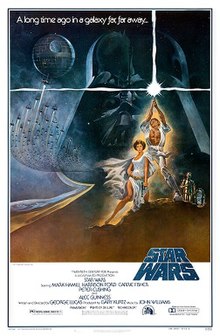
Star Wars (also known as Star Wars: Episode IV – A New Hope) is a 1977 American epic space-opera film written and directed by George Lucas. It is the first film in the original Star Wars trilogy and the beginning of the Star Wars franchise. Starring Mark Hamill, Harrison Ford, Carrie Fisher, Peter Cushing, Alec Guinness, David Prowse, James Earl Jones, Anthony Daniels, Kenny Baker, and Peter Mayhew, the film focuses on the Rebel Alliance, led by Princess Leia (Fisher), and its attempt to destroy the Galactic Empire’s space station, the Death Star.Film poster showing Luke Skywalker triumphantly waving a lightsaber in the air, Princess Leia sitting beside him, and R2-D2 and C-3PO staring at them. A figure of the head of Darth Vader and the Death Star with several starships heading towards it are shown in the background. Atop the image is the text "A long time ago in a galaxy far, far away..." Below is shown the film's logo, above the credits and the production details.

Directed by George Lucas
Produced by Gary Kurtz
Written by George Lucas
Starring
  • Mark Hamill- Luke Skywalker: a young man raised by his aunt and uncle on Tatooine, who dreams of something more than his current life and learns the way of a Jedi.
  • Harrison Ford as Han Solo: a cynical smuggler hired by Obi-Wan and Luke to take them to Alderaan in his ship, the Millennium Falcon, co-piloted with Chewbacca.
  • Carrie Fisher-Princess Leia: a member of the Imperial Senate and a leader of the Rebel Alliance.
  • Peter Cushing-Grand Moff Tarkin: Governor of the Imperial Outland Regions and commander of the Death Star.
  • Alec Guinness-Obi-Wan “Ben” Kenobi: an aging Jedi Master and former mentor of Darth Vader who introduces Luke to the Force.

From left to right: Luke Skywalker (Mark Hamill), Princess Leia (Carrie Fisher), and Han Solo (Harrison Ford)

  • Anthony Daniels as C-3PO: a protocol droid who is fluent in over six million forms of communication
  • Kenny Baker as R2-D2: an astromech droid who is carrying the Death Star plans and a secret message for Obi-Wan from Princess Leia.
  • Peter Mayhew as Chewbacca: a 200-year-old Wookiee, Han Solo’s sidekick, and first mate of the Millennium Falcon.
  • David Prowse as Darth Vader (voiced by James Earl Jones): A Sith Lord, second in command of the Galactic Empire, who hopes to destroy the Rebel Alliance. Lucas originally intended for Orson Welles to voice Vader (after dismissing using Prowse’s own voice due to his English West Country accent, leading to the rest of the cast nicknaming him “Darth Farmer”). After deciding that Welles’s voice would be too recognizable, he cast the lesser-known James Earl Jones instead.

. This poster shows a montage of scenes from the movie. Dominating the background is the dark visage of Darth Vader; in the foreground, Luke Skywalker sits astride a tauntaun; Han Solo and Princess Leia gaze at each other while in a romantic embrace; Chewbacca, R 2-D 2, and C-3PO round out the montage.

The Empire Strikes Back (also known as Star Wars: Episode V – The Empire Strikes Back) is a 1980 American epic space opera film directed by Irvin Kershner. Leigh Brackett and Lawrence Kasdan wrote the screenplay, with George Lucas writing the film’s story and serving as executive producer. The second installment in the original Star Wars trilogy, it was produced by Gary Kurtz for Lucasfilm and stars Mark Hamill, Harrison Ford, Carrie Fisher, Billy Dee Williams, Anthony Daniels, David Prowse, Kenny Baker, Peter Mayhew, and Frank Oz.

The film is set three years after Star Wars. The Galactic Empire, under the leadership of the villainous Darth Vader and the mysterious Emperor, is in pursuit of Luke Skywalker and the rest of the Rebel Alliance. While Vader relentlessly pursues the small band of Luke’s friends—Han Solo, Princess Leia Organa, and others—across the galaxy, Luke studies the Force under Jedi Master Yoda. When Vader captures Luke’s friends, Luke must decide whether to complete his training and become a Jedi Knight or to confront Vader and save them.

Directed by Irvin Kershner
Produced by Gary Kurtz
Screenplay by
  • Leigh Brackett
  • Lawrence Kasdan
Story by George Lucas
Starring
  • Mark Hamill -Luke Skywalker: A Jedi in training, who is powerfully connected with the Force.
  • Harrison Ford-Han Solo: A smuggler and Captain of the Millennium Falcon.
  • Carrie Fisher-Leia Organa: A leader of the Rebel Alliance, the former Princess of the destroyed planet Alderaan.
  • Billy Dee Williams-Lando Calrissian: Administrator of Cloud City and an old friend to Han Solo.
  • Anthony Daniels-C-3PO: A humanoid protocol droid in the Rebel Alliance
  • David Prowse’s Darth Vader: Luke’s father and a warrior of the dark side of the Force and the Emperor’s second-in-command. The character’s voice is provided by James Earl Jones.
  • Peter Mayhew-Chewbacca: A Wookiee and loyal friend to Han Solo.
  • Anthony Daniels as C-3PO: A humanoid protocol droid in the Rebel Alliance.
  • Kenny Baker as R2-D2An astromech droid in the Rebel Alliance and long-time friend to C-3PO
  • Frank Oz performing Yoda: The wise, centuries-old Grand Master of the Jedi, who is Luke’s self-exiled Jedi Master living on Dagobah.
  • Jeremy Bulloch as Boba Fett: A bounty hunter, hired by the Galactic Empire.
  • Alec Guinness appears briefly as Obi-Wan Kenobi’s Force ghost: Luke’s deceased mentor, who guides him to Yoda.

Return of the Jedi (also known as Star Wars: Episode VI – Return of the Jedi) is a 1983 American epic space-opera film directed by Richard Marquand. The screenplay is by Lawrence Kasdan and George Lucas from a story by Lucas, who was also the executive producer. It is the third installment in the original Star Wars trilogy, set one year after The Empire Strikes Back. The film stars Mark Hamill, Harrison Ford, Carrie Fisher, Billy Dee Williams, Anthony Daniels, David Prowse, Kenny Baker, Peter Mayhew and Frank Oz.. This poster shows a montage of characters from the movie. In the background, Darth Vader stands tall and dark in front of a reconstructed Death Star; before him stands Luke Skywalker wielding a lightsaber, Han Solo aiming a blaster, and Princess Leia wearing a slave outfit. To the right are an Ewok and Lando Calrissian, while miscellaneous villains fill out the left.

In the film, the Galactic Empire, under the direction of the ruthless Emperor, is constructing a second Death Star in order to crush the Rebel Alliance once and for all. Since the Emperor plans to personally oversee the final stages of its construction, the Rebel Fleet launches a full-scale attack on the Death Star in order to prevent its completion and kill the Emperor, effectively bringing an end to his hold over the galaxy. Meanwhile, Luke Skywalker struggles to bring his father Darth Vader back to the light side of the Force.

In an attempt to rescue Han Solo from crimelord Jabba the Hutt, C-3PO and R2-D2 are sent to Jabba’s palace on Tatooine in a trade bargain made by Luke Skywalker. Disguised as a bounty hunter, Princess Leia infiltrates the palace under the pretense of collecting the bounty on Chewbacca and unfreezes Han, but is caught and enslaved. Luke arrives soon afterward, but after a tense standoff, is sent through a trapdoor to do battle with Jabba’s rancor. Jabba sentences Luke and Han to death by being fed to the Sarlacc. Having hidden his lightsaber inside R2-D2, Luke frees himself and battles Jabba’s guards while Leia uses her chains to strangle Jabba. As the others rendezvous with the Rebel Alliance, Luke returns to Dagobah, where he finds that Yoda is dying. Yoda confirms that Darth Vader, once known as Anakin Skywalker, is Luke’s father, and the Force ghost of Obi-Wan Kenobi reveals that Leia is Luke’s twin sister. The Jedi Masters tell Luke that he must face Vader again to finish his training and defeat the Empire. As Yoda disappears, he becomes one with the Force…….

Directed by Richard Marquand
Produced by Howard Kazanjian
Screenplay by
  • Lawrence Kasdan
  • George Lucas
Story by George Lucas
Starring
  • Mark Hamill-Luke Skywalker: One of the last living Jedi, trained by Obi-Wan and Yoda, who is also a skilled X-wing fighter pilot allied with the Rebellion
  • Harrison Ford-Han Solo: A rogue smuggler, who aids the Rebellion against the Empire. Han is Luke and Leia’s friend, as well as Leia’s love interest
  • Carrie Fisher-Leia Organa: The former princess of the destroyed planet Alderaan, who is part of the Rebellion; Luke’s twin sister, and Han’s love interest
  • Billy Dee Williams-Lando Calrissian: The former Baron Administrator of Cloud City and one of Han’s friends who aid the Rebellion
  • Anthony Daniels-C-3PO: A humanoid protocol droid in the service of the Rebellion
  • David Prowse- Darth Vader: A powerful Sith Lord and the second in command of the Galactic Empire; Luke and Leia’s father
  • Kenny Baker
  • Peter Mayhew Chewbacca: A Wookiee who is Han’s longtime friend and part of the Rebellion
  • Frank Oz-Yoda: The wise, centuries-old Jedi Master, who lives on Dagobah and trained Luke. After dying, he reappears to Luke as a Force ghost.
  • James Earl Jones as the voice of Darth Vader
  • Sebastian Shaw as Anakin Skywalker: After defeating the Emperor, Vader asks Luke to take off his mask so he can see his son clearly before he dies. Originally, Shaw also appeared as Anakin’s Force ghost.
  • Hayden Christensen as Anakin’s Force ghost: In the 2004 DVD release of the original trilogy, the actor who portrayed Anakin in the second and third prequel films replaces Shaw as the character’s Force ghost; this change was intended to bring Return of the Jedi into continuity with the larger saga.
  • Alec Guinness as Obi-Wan Kenobi: A deceased Jedi Master, who continues to teach Luke after death as a Force ghost
  • Denis Lawson reprises his role as Wedge Antilles from Star Wars, and Kenneth Colley and Jeremy Bulloch reprise their roles as Admiral Piett and Boba Fett from The Empire Strikes Back. Michael Pennington portrays Moff Jerjerrod, the commander of the second Death Star. Warwick Davis appears as Wicket W. Warrick, an Ewok who leads Leia and eventually her friends to the Ewok tribe.

Star Wars: The Force Awakens (also known as Star Wars: Episode VII – The Force Awakens) is a 2015 American epic space-opera film produced, co-written and directed by J. J. Abrams. It is the first installment of the Star Wars sequel trilogy, following Return of the Jedi (1983), and the seventh episode of the main Star Wars film franchise. The film stars Harrison Ford, Mark Hamill, Carrie Fisher, Adam Driver, Daisy Ridley, John Boyega, Oscar Isaac, Lupita Nyong’o, Andy Serkis, Domhnall Gleeson, Anthony Daniels, Peter Mayhew, and Max von Sydow, and was produced by Lucasfilm Ltd., Abrams’s production company Bad Robot Productions and distributed by Walt Disney Studios Motion Pictures. The Force Awakens is the first Star Wars film to not significantly involve franchise creator George Lucas. Set 30 years after Return of the Jedi, the film follows Rey, Finn, and Poe Dameron’s search for Luke Skywalker and their fight alongside the Resistance, led by General Leia Organa and veterans of the Rebel Alliance, against Kylo Ren and the First Order, a successor to the Galactic Empire.

Thirty years after the Galactic Civil War, the First Order has risen from the fallen Galactic Empire and seeks to eliminate the New Republic. The Resistance, backed by the Republic and led by General Leia Organa, opposes them while Leia searches for her brother, Luke Skywalker.

On the planet Jakku, Resistance pilot Poe Dameron receives a map to Luke’s location from Lor San Tekka. Stormtroopers commanded by Kylo Ren destroy the village and capture Poe, while Kylo kills San Tekka. Poe’s droid BB-8 escapes with the map and encounters a scavenger, Rey, near a junkyard settlement. Kylo tortures Poe using the Force and learns of BB-8. Stormtrooper FN-2187, unwilling to kill for the First Order, frees Poe, and they escape in a stolen TIE fighter; Poe names FN-2187 “Finn”. As they turn back to Jakku to retrieve BB-8, they are shot down by a First Order Star Destroyer and crash-land. Finn survives and assumes that Poe died in the crash. He encounters Rey and BB-8, but the First Order tracks them and launches an airstrike. Finn, Rey, and BB-8 flee the planet in the Millennium Falcon, which they steal from a junkyard…..

Star Wars The Force Awakens Theatrical Poster.jpg

Directed by J. J. Abrams
Produced by
  • Kathleen Kennedy
  • J. J. Abrams
  • Bryan Burk
Written by
  • Lawrence Kasdan
  • J. J. Abrams
  • Michael Arndt
Based on Characters
by George Lucas
Starring
  • Harrison Ford- Han Solo
    A rogue and a smuggler, formerly a key player in the Rebel Alliance.
  • Mark Hamill- Luke Skywalker
    The last Jedi, who has gone into hiding
  • Carrie Fisher-General Leia Organa Solo

The former princess of the destroyed planet Alderaan, now General of the Resistance, and Luke’s twin sister.

  • Adam Driver-Kylo Ren:

A dark warrior who is strong with the Force, the leader of the Knights of Ren, and a high-ranking member of the First Order. He is the son of Han and Leia the nephew of Luke Skywalker and the grandson of the deceased Darth Vader and-Padmé Amidala


  • Daisy Ridley –Rey:

A highly Force-sensitive scavenger who was abandoned as a child on the desert planet Jakku and awaits her family’s return

  • John Boyega -Finn:
A reformed First Order stormtrooper
  • Oscar Isaac-Poe Dameron:

A Resistance X-wing fighter pilot.

  • Lupita Nyong’o- Maz Kanata 
    A wise and perceptive figure operating a somewhat shady cantina on the peaceful forest planet Takodana
  • Andy Serkis -Supreme Leader Snoke:

The political leader of the First Order. He is Kylo Ren’s master and is very powerful in the dark side of the Force

  • Domhnall Gleeson -General Hux:

The commander of the First Order’s Starkiller Base

  • Anthony Daniels-C-3PO:

A humanoid protocol droid in Organa’s service

  • Peter Mayhew Chewbacca Wookiee and Solo’s longtime companion.
  • Max von Sydow as Lor San Tekka:

Ewan McGregor has an uncredited vocal cameo as Obi-Wan Kenobi in Rey’s vision sequence, while archival audio of Frank Oz and Alec Guinness as Yoda and Kenobi, respectively, are also used in the same scene; Oz recorded new dialogue for the film, but it was replaced with preexisting audio from The Empire Strikes Back.

Star Wars: The Last Jedi (also known as Star Wars: Episode VIII – The Last Jedi) is a 2017 American epic space opera film written and directed by Rian Johnson. It is the second installment of the Star Wars sequel trilogy, following The Force Awakens (2015), and the eighth episode of the main Star Wars film franchise. It was produced by Lucasfilm and distributed by Walt Disney Studios Motion Pictures. The film’s ensemble cast includes Mark Hamill, Carrie Fisher, Adam Driver, Daisy Ridley, John Boyega, Oscar Isaac, Andy Serkis, Lupita Nyong’o, Domhnall Gleeson, Anthony Daniels, Gwendoline Christie, and Frank Oz in returning roles, with Kelly Marie Tran, Laura Dern, and Benicio del Toro joining the cast. It features the first posthumous film performance by Fisher, who died in December 2016, and the film is dedicated to her memory. The plot follows Rey as she receives Jedi training from Luke Skywalker, in hopes of turning the tide for the Resistance in the fight against Kylo Ren and the First Order, while General Leia Organa, Finn, and Poe Dameron attempt to escape a First Order attack on the dwindling Resistance fleet.

Following the destruction of Starkiller Base, General Leia Organa leads the flight of Resistance forces from D’Qar, when a First Order fleet arrives. Poe Dameron leads a costly counterattack that destroys a First Order dreadnought, and the remaining Resistance escapes into hyperspace. Rey, having traveled to Ahch-To with Chewbacca and R2-D2 aboard the Millennium Falcon, attempts to recruit Luke Skywalker to the Resistance. Disillusioned by his failure to train Kylo as a Jedi, and under self-imposed exile, Luke refuses to help and says that the Jedi should end. Meanwhile, the First Order uses a device to track the Resistance and attacks them. Leia’s son Kylo Ren hesitates to fire on the lead Resistance ship after sensing his mother’s presence, but his wingmen destroy the bridge, killing most of the Resistance’s leaders. Leia is sucked into space but survives by using the Force.

Encouraged by R2-D2, Luke decides to train Rey as a Jedi. Rey and Kylo begin communicating through the Force, puzzling them both. After Kylo tells Rey what happened between him and Luke that caused him to choose the dark side, Luke confesses that he momentarily contemplated killing Kylo upon sensing that Snoke was corrupting him; this prompted Kylo to destroy Luke’s new Jedi Order. Convinced that Kylo can be redeemed, Rey leaves Ahch-To. Luke prepares to burn the Jedi library but hesitates. Yoda’s Force ghost appears and destroys the library by summoning a bolt of lightning, saying Rey has all she needs to learn and encourages Luke to learn from his failure…..

Directed by Rian Johnson
Produced by
  • Kathleen Kennedy
  • Ram Bergman
Written by Rian Johnson
Based on Characters
by George Lucas
Starring
  • Mark HamillLuke Skywalker, a powerful Jedi Master who has been in self-imposed exile on the planet Ahch-To.
  • Carrie FisherGeneral Leia Organa, twin sister to Luke, a former princess of Alderaan, and a leading general in the Resistance
  • Adam DriverKylo Ren, Supreme Leader Snoke’s disciple, who is strong with the Force and leader to the Knights of Ren. He is the son of Han Solo and Leia Organa, nephew of Luke Skywalker, and the grandson of Anakin and Padmé Amidala
  • Daisy Ridley Rey, a highly Force-sensitive scavenger from the desert planet Jakku who joined the Resistance and goes to find Luke Skywalker
  • John Boyega-Finn, a former stormtrooper of the First Order who defected to the Resistance
  • Oscar Isaac -Poe Dameron, a high-ranking X-wing fighter pilot in the Resistance
  • Andy Serkis-Supreme Leader Snoke, the leader of the First Order and Kylo Ren’s master
  • Lupita Nyong’o -Maz Kanata, a pirate and ally of the Resistance
  • Domhnall Gleeson-General Hux, the former head of the First Order’s Starkiller Base
  • Anthony Daniels-C-3PO, a humanoid protocol droid in the service of Leia Organa.
  • Gwendoline Christie-Captain Phasma, the commander of the First Order’s stormtroopers.
  • Kelly Marie Tran-Rose Tico, a member of the Resistance who at the beginning works in maintenance
  • Laura Dern-Vice Admiral Amilyn Holdo, an officer in the Resistance
  • Benicio del Toro-Yoda, the deceased former Grand Master of the Jedi, and Luke’s wise former mentor, who appears as a Force-ghost
  • Benicio del Toro as DJ, an underworld codebreaker.

Star Wars: The Rise of Skywalker (also known as Star Wars: Episode IX – The Rise of Skywalker) is an upcoming American epic spaceopera film produced, co-written and directed by J. J. Abrams. It will be the third installment of the Star Wars sequel trilogy, following The Force Awakens (2015) and The Last Jedi (2017), and the ninth and final episode of the main Star Wars film franchise. The film was produced by Lucasfilm, Abrams’s production company Bad Robot Productions and is scheduled to be distributed by Walt Disney Studios Motion Pictures. The film’s ensemble cast includes Daisy Ridley, Adam Driver, John Boyega, Oscar Isaac, Lupita Nyong’o, Domhnall Gleeson, Kelly Marie Tran, Joonas Suotamo, Billie Lourd, Naomi Ackie, Richard E. Grant, Keri Russell, Mark Hamill, Anthony Daniels, Carrie Fisher, Billy Dee Williams and Ian McDiarmid; the latter two return to the franchise onscreen for the first time since 1983’s Return of the Jedi and 2005’s Revenge of the Sith, respectively.

Star Wars Episode IX poster.jpg

Directed by J. J. Abrams
Produced by
  • Kathleen Kennedy
  • J. J. Abrams
  • Michelle Rejwan
Written by
  • J. J. Abrams
  • Chris Terrio
Based on Star Wars
by George Lucas
Starring
  • Daisy Ridley
  • Adam Driver
  • John Boyega
  • Oscar Isaac
  • Lupita Nyong’o
  • Domhnall Gleeson
  • Kelly Marie Tran
  • Joonas Suotamo
  • Billie Lourd
  • Naomi Ackie
  • Richard E. Grant
  • Keri Russell
  • Mark Hamill
  • Anthony Daniels
  • Billy Dee Williams
  • Carrie Fisher
  • Ian McDiarmid
  • Daisy Ridley as Rey, a young woman from Jakku who is the last Jedi apprentice of Luke Skywalker
  • Adam Driver as Kylo Ren, the Supreme Leader of the First Order; the son of Leia Organa and Han Solo
  • John Boyega as Finn, a stormtrooper of the First Order who has defected to the Resistance
  • Oscar Isaac as Poe Dameron, a high-ranking X-wing fighter pilot and commander of the Resistance
  • Lupita Nyong’o as Maz Kanata, a former space pirate, and ally of the Resistance
  • Domhnall Gleeson as Hux, the First Order’s second-in-command and former commander of Starkiller Base
  • Kelly Marie Tran as Rose Tico, a mechanic in the Resistance
  • Joonas Suotamo as Chewbacca, a Wookiee and first mate of the Millennium Falcon
  • Billie Lourd as Lieutenant Connix, an officer in the Resistance
  • Naomi Ackie as Jannah
  • Richard E. Grant
  • Keri Russell
  • Mark Hamill as Luke Skywalker, son of Anakin and, Queen Padmé Amidala,  and twin brother of  Leia Organa and the last Jedi Master, who vanished in The Last Jedi
  • Anthony Daniels as C-3PO, a humanoid protocol droid in the service of General Leia Organa
  • Billy Dee Williams as Lando Calrissian, a veteran of the Rebel Alliance and old friend of Han’s
  • Carrie Fisher as Leia Organa, daughter of Anakin and, Queen Padmé Amidala, the Force-sensitive leading general of the Resistance and Luke’s sister
  • Ian McDiarmid as Palpatine / Darth Sidious, the former emperor of the galaxy and Dark Lord of the Sith who died in Return of the Jedi

What is Yoga?

Yoga is a group of physical, mental, and spiritual practices or disciplines which originated in ancient India. Yoga is one of the six orthodox schools of Hindu philosophical traditions. There is a broad variety of yoga schools, practices, and goals in Hinduism, Buddhism, and Jainism.Image result for yoga


Related image


10 Really Amazing Health Benefits of Yoga

Benefiting the mind, body, and soul

But following is a brief highlight of some of the reasons you should consider adding yoga to your world. Here are 10 health benefits of yoga.

1. Strength, Agility, and Flexibility are all Increased

Many sports will give you strength. Others will give you more agility, but few practices will increase strength, agility, and flexibility all at once. In my years of teaching, I’ve seen professional athletes overcome injury by increasing their range of motion with yoga, and victims of a double mastectomy regain full mobility after debilitating surgeries that left loads of scar tissue in their bodies. Nothing really compares for repairing the body and making sure that the ligaments and connective tissues are just as strong and pliable as the muscles themselves.

2. Yoga Enhances Memory & Cognitive Functioning

It may seem strange that a practice which involves breathing and stretching can enhance your cognitive functioning, but yogis could really be better at learning, have increased memory capacity, and retain high levels of concentration. Many of these benefits are attributed to meditation – arguably the goal of all yogic practice, but it can also help you at school or on the job by improving your brain functioning.

3. Body Weight Normalizes – More Health Benefits of Yoga

While doing an hour of hatha yoga, or even power yoga won’t likely burn as many calories as doing a high-intensity interval workout, yoga has a way of normalizing body weight by restoring hormonal balance in the body.

By lowering levels of cortisol and our nervous system’s constant fight or flight response, not only are we less likely to overeat, or eat to suppress unpleasant emotions, we also train our brains to feel satiated more easily because we aren’t constantly in panic mode. Stress is known to cause obesity and fuel virtually all disease, and yoga is a perfect countermeasure.

4Yoga Naturally Reduces Pain

There are countless studies proving that yoga can be very effective at relieving pain. It doesn’t matter if you suffer from fibromyalgia, arthritis, or migraine headaches, yoga has been proven to effectively reduce pain from all these ailments. And if you are one of the millions of people that suffer from back pain – yoga can make that pain practically disappear.

Meditation has even been shown to be better than morphine at reducing pain.

5. Respiratory Efficiency Increases

Further adding on to the health benefits of yoga, yoga is one of the few practices that utilizes pranayama – the cultivation of life force or chi through breathing. While many people practice pranayama as a means to obtain higher states of awareness, they also end up having some serious side benefits including increased lung capacity, more tidal volume (the total amount of air your lungs can hold at any one time), and an ability to reduce the pace of their breathing which has been directly linked to a longer lifespan.

  1. Blood Pressure is Normalized

Yoga has specific benefits for hyporeactors in blood pressure. For those suffering from hypertension, yoga has been shown to be even more effective than dietary changes for improving blood pressure.

7. Mental Health is Greatly Enhanced

Yoga offers so many benefits in the psychological department it is difficult to name them all in a brief overview, but among them are an improved overall mood and sense of well-being, more connectedness with others, lowered depressive states, less hostility toward the self and others, less anxiety, feelings of self-actualization increase, motivation increases, and more.

8. Yoga Prevents Degenerative Diseases  -The ways in which yoga prevents disease are astounding. When you really understand how, it can be more evidence than you would ever need to take to the yoga mat, stat! Here are just some of the reasons yoga helps to keep you young and healthy longer:


  • Glucose decreases
  • Sodium decreases
  • Total cholesterol decreases
  • Triglycerides decrease
  • HDL cholesterol increases
  • LDL cholesterol decreases
  • VLDL cholesterol decreases
  • Cholinesterase increases
  • Catecholamines decrease
  • ATPase increases
  • Hematocrit increases
  • Hemoglobin increases
  • Lymphocyte count increases
  • Total white blood cell count decreases
  • Thyroxin increases
  • Bioavailable Vitamin C increases
  • Total serum protein increases
  • Oxytocin increases
  • Prolactin increases


9. The Parasympathetic Nervous System Takes over in Yoga

Why is this a good thing? Both the parasympathetic and sympathetic nervous systems work to keep us stabilized in the face of stress. These systems are connected like a see-saw. When one goes up the other goes down. When the sympathetic nervous system is active, it usually means we are on ‘high-alert’ either responding to stress or trying to minimize it.

This is the part of our nervous systems that are most often triggered – from flashing lights, traffic noises, emails from our co-workers or boss, family responsibilities, etc. Yoga strengthens the activity of the parasympathetic nervous system which is primarily responsible for the ‘relaxation response.’

Obviously, you wouldn’t want to constantly be zoned out or lethargic, nor perpetually on high-alert, so yoga helps to put the circular motion, the balance, back into the two nervous system’s dance.

10. You Can Do Yoga Anywhere

Perhaps one of the most convenient health benefits of yoga is that you can experience them just about anywhere. I’ve done yoga in studios, at the airport, in my home, at a friend’s home, in hotel rooms, outdoors in parks and forests, even on top of rocks, or on the rooftops of tall buildings in a busy city. You don’t need anything (except maybe a yoga mat) but even that isn’t really necessary to do yoga.

There are no gym memberships required and no expensive gear. You don’t have to be in shape to start, and it will continue to challenge you even if you are in shape. Yoga is timeless and can be done almost anywhere without a great const or inconvenience.

For even more reasons to practice yoga, visit a class in your area and learn first hand what it can do for you.

Maintaining a regular yoga practice can provide physical and mental health benefits

Learn about the different types of yoga and how it can be used as a tool to help you stay healthy.

Like yoga, the osteopathic approach to wellness focuses on your body’s natural tendency toward health and self-healing.

“The purpose of yoga is to build strength, awareness, and harmony in both the mind and body,” explains Natalie Nevins, DO, a board-certified osteopathic family physician and certified Kundalini Yoga instructor in Hollywood, California.

While there are more than 100 different types, or schools, of yoga, most sessions typically include breathing exercises, meditation, and assuming postures (sometimes called asana or poses) that stretch and flex various muscle groups.

“As an osteopathic physician, I focus a lot of my efforts on preventive medicine and practices, and in the body’s ability to heal itself,” says Dr. Nevins. “Yoga is a great tool for staying healthy because it’s based on similar principles.”

Physical benefits

“The relaxation techniques incorporated in yoga can lessen chronic pain, such as lower back pain, arthritis, headaches, and carpal tunnel syndrome,” explains Dr. Nevins. “Yoga can also lower blood pressure and reduce insomnia.”

Other physical benefits of yoga include:


  • Increased flexibility
  • Increased muscle strength and tone
  • Improved respiration, energy and vitality
  • Maintaining a balanced metabolism
  • Weight reduction
  • Cardio and circulatory health
  • Improved athletic performance
  • Protection from injury


Mental benefits

Aside from the physical benefits, one of the best benefits of yoga is how it helps a person manage stress, which is known to have devastating effects on the body and mind. “Stress can reveal itself in many ways, including back or neck pain, sleeping problems, headaches, drug abuse, and an inability to concentrate,” says Dr. Nevins. “Yoga can be very effective in developing coping skills and reaching a more positive outlook on life.”

Yoga’s incorporation of meditation and breathing can help improve a person’s mental well-being. “Regular yoga practice creates mental clarity and calmness; increases body awareness; relieves chronic stress patterns; relaxes the mind; centers attention, and sharpens concentration,” says Dr. Nevins. Body- and self-awareness are particularly beneficial, she adds, “because they can help with early detection of physical problems and allow for early preventive action.”

Beginners welcome

Because there are so many different kinds of yoga practices, it is possible for anyone to start. “Whether you’re a couch potato or a professional athlete, size and fitness levels do not matter because there are modifications for every yoga pose and beginner classes in every style,” says Dr. Nevins. “The idea is to explore your limits, not strive for some pretzel-like perfection. It is a great way to get in tune with your body and your inner self.”​

Is yoga good for anxiety?

Available reviews of a wide range of yoga practices suggest they can reduce the impact of exaggerated stress responses and may be helpful for both anxiety and depression. In this respect, yoga functions like other self-soothing techniques, such as meditation, relaxation, exercise, or even socializing with a friend

How healthy is yoga?

Workout fads come and go, but virtually no other exercise program is as enduring as yoga. It’s been around for more than 5,000 years. Yoga does more than burn calories and tone muscles. It’s a total mind-body workout that combines strengthening and stretching poses with deep breathing and meditation or relaxation

Is yoga a good workout? Workout fads come and go, but virtually no other exercise program is as enduring as yoga. … Yoga does more than burn calories and tone muscles. It’s a total mind-body workout that combines strengthening and stretching poses with deep breathing and meditation or relaxation. There are more than 100 different forms of yoga.

Which yoga is best for depression?    Boost feel-good endorphins with these yoga poses for depression.

  • Bound Angle Pose. Baddha Konasana.
  • Bridge Pose. Bridge Pose can be whatever you need—energizing, rejuvenating, or luxuriously restorative.
  • Corpse Pose. Savasana.
  • Dolphin Plank Pose.
  • Dolphin Pose.
  • Easy Pose. Sukhasana.
  • Extended Puppy Pose. …
  • Feathered Peacock Pose

Why yoga helps with stress?

Yoga: Fight stress and find serenity. … Yoga is a mind-body practice that combines physical poses, controlled breathing, and meditation or relaxation. Yoga may help reduce stress, lower blood pressure and lower your heart rate. And almost anyone can do it.

Is yoga good for depression?

Yoga is a physical exercise that involves different body poses, breathing techniques, and meditation. The therapy may help with depression and your symptoms, such as difficulty concentrating or loss of energy. Many people use yoga therapy to manage: mental and emotional problems, such as stress, anxiety, or depression.

Does yoga help with anxiety and panic attacks?

Six Yoga Poses to Help with Anxiety and Panic Attacks. “Take a deep breath. … The ancient practice of yoga is made up of three main ingredients: breathing, meditation, and asana (physical postures). Each factor alone has been proven to help relieve anxiety, but combining all three can increase the benefits.

How does yoga help your mental health?

Yoga increases body awareness, relieves stress, reduces muscle tension, strain, and inflammation, sharpens attention and concentration, and calms and centers the nervous system. Yoga’s positive benefits on mental health have made it an important practice tool of psychotherapy (American Psychological Association).

How does sleep reduce stress?

Stress and sleep have a two-way relationship. High stress levels can make sleeping more difficult. They can even lead to sleep disorders. At the same time, getting a good night’s sleep can help reduce the effects of stress.

How does meditation reduce stress?

Meditation May Reduce Stress and Improve Health. A simple technique practiced for as few as 10 minutes per day can help you control stress, decrease anxiety, improve cardiovascular health, and achieve a greater capacity for relaxation.

How do you breathe during a panic attack?

Calming Breath


  • Take a long, slow breath in through your nose, first filling your lower lungs, then your upper lungs.
  • Hold your breath to the count of “three.”
  • Exhale slowly through pursed lips, while you relax the muscles in your face, jaw, shoulders, and stomach.


How can I reduce stress and sleep?

Tips for lowering stress levels at bedtime


  • Plan an hour of quiet time before bedtime when you focus on doing activities that promote rest. …
  • Make your bed a cue for sleep by moving wakeful activities (e.g., screen time, working, worrying, planning) out of the bed.
  • Go to bed only when you are sleepy.


What is the relationship between stress and sleep?

The relationship between stress and sleep is a vicious circle. Too much stress, be it regarding financial concerns, health problems or relationships, makes it harder to sleep. A lack of sleep, however, only increases the amount of stress that you feel because your sleep-deprived body churns out more stress hormones.


Image result for yoga


Mental health on the bookshelf:

 The best self-help books

Self Help is a book club and community dedicated to self-help and self-development.

Visit shelfhelp.club for more information on the Book of the Month as well as meet-ups and author events

But there are thousands of books available offering advice and strategies to help live with the various forms, from OCD to depression, anxiety to autism, as well as stories of support from others that have been lost and found and want to share the message that, however, we are feeling, we are not alone.

In the words of Reasons to Stay Alive author Matt Haig: “Words, just sometimes, really can set you free.”

Mad Girl by Bryony Gordon –From running the marathon in her bra and pants to getting Prince Harry to share his own, very personal stories, Gordon has done a lot to highlight mental health. But it’s her own frank and funny story about life with OCD that will really offer comfort to anyone feeling alone in their compulsions.

Reasons To Stay Alive by Matt Haig –A book on depression that everyone should read, whether you suffer with mental illness or not. This award-winning ‘modern classic’ is as much a celebration of being alive as a look at the dark side of living. And its core message is the most important of all – that nothing is ever hopeless. (And a PS for any self-help super geeks out there, Haig’s follow-up ‘Notes on a Nervous Planet’ is out in July).

The Little Book of Mindfulness by Patrizia Collard –Can you find 10 minutes a day? Or even just 5? That’s all you need to reduce stress, improve mindfulness and find more peace in your life, according to this best-selling mini book. 

The Upside of Stress by Kelly McGonigal –If you can’t stop stressing, then you may as well learn how to do it better! In this book Health Psychologist Kelly McGonigal argues that a) stress can be GOOD for us and b) by embracing stress and changing our thinking, it could actually become a powerful ally.

May The Thoughts Be With You by Charlotte Reed –Artist Charlotte Reed doodled herself out of depression, and the colorful characters she created went on to star in their own picture book of ‘thoughts and wisdom to inspire your days.’

How to be Human: A Manual by Ruby Wax –So, there is a manual! And this book, a three-way production from the comedian, a monk, and a neuroscientist, has been billed as a ‘handbook for those in despair.’ Wax promises that it ‘answer every question you’ve ever had about: evolution, thoughts, emotions, the body, addictions, relationships, kids, the future and compassion.’

The Anxiety Journal by Corrine Sweet –Journaling is a powerful tool for calming the mind and putting a different perspective on situations so it lends itself brilliantly to helping deal with anxiety. This book is filled with exercises to soothe stress on the go as well as keep track of how far you have come.


MUST-READ BOOKS ABOUT MENTAL ILLNESS


  • 72 Hour Hold – Bebe Moore Campbell
  • All the Bright Places – Jennifer Niven
  • All the Things We Never Knew: Chasing the Chaos of Mental Illness – Sheila Hamilton
  • Americanah – Chimamanda Ngozi Adichie
  • The Awakening – Kate Chopin
  • Awakening Kali – T. S. Gho
  • Bleeding Violet – Dia Reeves
  • The Buddha and the Borderline: My Recovery from Borderline Personality Disorder through Dialectical Behavior Therapy, Buddhism, and Online Dating – Kiera Van Gelder
  • The Color of Hope: People of Color Mental Health Narratives – ed. Vanessa Hazzard
  • The Color Purple – Alice Walker
  • Crazy – Han Nolan
  • Darkness Visible – William Styron
  • Dragonfish – Vu Tran
  • Every Last Word – Tamara Ireland Stone
  • Everything, Everything – Nicola Yoon
  • Everything I Never Told You – Celeste Ng
  • Fangirl – Rainbow Rowell
  • Find You in the Dark – A. Meredith Walters
  • Flowers From the Storm – Laura Kinsale
  • Franny and Zooey – J. D. Salinger
  • Furiously Happy – Jenny Lawson
  • Get Me Out of Here: My Recovery from Borderline Personality Disorder – Rachel Reiland
  • Haldol and Hyacinths: A Bipolar Life – Melody Moezzi
  • Hamlet – William Shakespeare
  • The Hours – Michael Cunningham
  • Hyperbole and a Half: Unfortunate Situations, Flawed Coping Mechanisms, Mayhem, and Other Things That Happened – Allie Brosh
  • Imagine Me Gone – Adam Haslett
  • Impulse – Ellen Hopkins
  • It’s Kind of a Funny Story – Ned Vizzini
  • The Last Time We Said Goodbye – Cynthia Hand
  • Keep Me Still – Caisey Quinn
  • Let the Tornado Come – Rita Zoey Chin
  • A Little Life – Hanya Yanagihara
  • Look Straight Ahead – Elaine M. Will
  • Looking for Alaska – John Green
  • Loud in the House of Myself: Memoir of a Strange Girl – Stacy Pershall
  • Made You Up – Francesca Zappia
  • Madness: A Bipolar Life – Marya Hornbacher
  • The Madness of Lord Ian Mackenzie – Jennifer Ashley
  • The Man Who Couldn’t Stop: OCD and the True Story of a Life Lost in Thought
  • Manic: A Memoir – Terri Cheney
  • Marbles: Mania, Depression, Michelangelo and Me – Ellen Forney
  • The Marriage Plot – Jeffrey Eugenides
  • The Memory of Light – Francisco X. Stork
  • Mrs. Dalloway – Virginia Woolf
  • More Happy Than Not – Adam Silvera
  • My Age of Anxiety: Fear, Hope, Dread, and the Search for Peace of Mind – Scott Stossel
  • My Heart and Other Black Holes – Jasmine Warga
  • The Nest – Kenneth Oppel
  • The Noonday Demon: An Atlas of Depression – Andrew Solomon
  • Norwegian Wood by Haruki Murakami
  • Not Alone: Reflections on Faith and Depression – Monica A. Coleman
  • A Note of Madness – Tabitha Suzuma
  • Ophelia Speaks: Adolescent Girls Write About Their Search for Self – Sara Shandler
  • Out of Her Mind: Women Writing on Mental Illness – Rebecca Shannonhouse (ed.)
  • Paperweight – Meg Haston
  • Polarity – Max Bemis
  • Prozac Nation – Elizabeth Wurtzel
  • Psychiatric Tales: Eleven Graphic Stories about Mental Illness – Daryl Cunningham
  • The Quiet Room: A Journey Out of the Torment of Madness – Lori Schiller
  • Reasons To Stay Alive – Matt Haig
  • The Round House by Louise Erdrich
  • The Salt Eaters – Toni Cade Bambara
  • Shadows in the Sun: Healing from Depression and Finding the Light Within – Gayathri Ramprasad
  • She’s Come Undone – Wally Lamb
  • The Silver Linings Playbook– Matthew Quick
  • Skinny – Donna Cooner
  • Sparks Off You – Anita Felicelli
  • Stop Pretending: What Happened When My Big Sister Went Crazy – Sonya Sones
  • Therapy – Kathryn Perez
  • Thirteen Reasons Why – Jay Asher
  • The Unlikely Hero of Room 13B – Teresa Toten
  • An Unquiet Mind – Kay Redfield Jamison
  • Your Voice is All I Hear – Leah Scheier
  • When Reason Breaks – Cindy L. Rodriguez
  • When We Collided – Emery Lord
  • White Oleander – Janet Fitch
  • Wide Sargasso Sea – Jean Rhys
  • Willow – Julia Hoban
  • Willow Weep for Me: A Black Woman’s Journey through Depression – Meri Nana-Ama Danquah
  • Wintergirls – Laurie Halse Anderson
  • The Woman in White – Wilkie Collins
  • The Yellow Wallpaper – Charlotte Perkins Gilman

9 Ways To Stop Mental Health Stigma That You Can Start Doing Today


Mental illness, while often challenging, is very, very, very common. According to the National Alliance on Mental Illness (NAMI), about one in five adults experience some form of mental health issue in any given year in the United States. The Centers for Disease Control (CDC) report that mental health conditions are widespread and that as many as 50 percents of people in the United States will experience a mental health condition at some point in their lives. Given these statistics, it’s clear that many people encounter mental health challenges in their lifetime. Yet, despite the fact that so many of us either manage mental health issues every day or know someone who does, stigmas surrounding mental illness persist. One way to stop these stigmas in their tracks? These small but powerful ways to stop mental health stigma are actions we can all start doing in our daily lives. So, whether you manage mental health illnesses yourself, or care about someone who does, there are ways that you can help. Here are nine actionable steps you can take every day to help stop mental health stigma while helping raise awareness and visibility for people living with mental health conditions.

1 Check In With Your Friends

Jackson says that one of the best ways to up visibility for mental health conditions is to check in with the people in your life and find out how they’re really feeling. If you think someone in your life might be going through a hard time, but is hesitant to say how they really feel, Jackson suggests asking, “How are you *really* doing?” If someone in your life is dealing with mental or emotional distress, Jackson says, check in to make sure that they’re alright.

2 Show Vulnerability In Ways That Feel Safe

Jackson notes that you can help normalize mental health issues by sharing your own experiences with others. “Self-disclose as much as you feel comfortable, Jackson recommends. “It feels good to know that others are going through, or have gone through, similar circumstances.””Also, don’t just share the negative, but also provide others with the steps or solutions as to how they can tackle the same problem,” Jackson further suggests. Psychology Today reports that self-disclosure can bring relief and improve relationships for people managing mental illness, as long as you talk to people who you trust. No rush, and no pressure.

3 Encourage People Seeking Mental Health Care

If someone you love decides to get mental health treatment, support them in that decision, Jackson says. While friends and family often mean well, they may lack the tools a person managing mental illness needs to get better. Minimizing or invalidating someone’s mental health symptoms, or viewing the need for treatment as a weakness, for instance, can cause harm.

“The wrong advice can potentially make things worse,” Jackson says. “A professional can help start the healing process, help them obtain positive coping skills, and find the best ways to deal with their mental health challenges.”

4…But Don’t Pressure Them To Do So

Jackson notes that, while seeking professional help can be lifesaving for some people managing mental illness, it’s not accessible for everyone. “Outside of fear, there are still other barriers individuals may face when attempting to get the mental health services they need.” Cost barriers, cultural stigma, and lack of access to health insurance can all keep people from receiving necessary treatment. Jackson suggests that books, articles, and online support groups can be accessible options if traditional therapy isn’t available to someone

5 Be Willing To Engage In Conversations About Stigma

According to Psychology Today, many people internalize cultural mental health stigmas. People with self-stigma might feel bad about themselves if they’re going through a hard time, or finding it difficult to cope. Also, some people who don’t live with mental illness might internalize prejudices against those who do. Interrupting harmful speech in safe ways, and engaging in conversations that challenge stereotypes and stigma, can help bring about positive change.

6 Listen

Someone dealing with mental health issues might be concerned about how their condition “will affect their life overall,” notes Jackson. “So, instead of trying to find a solution to their problem and being the ‘fixer,’ just listen. Do not try to provide a solution, just be present,” Jackson says. “Your non-judgmental presence can be more healing than you think.” Saying something like, ‘I hear you,’ or ‘I’m listening,’ while saving your advice until it’s explicitly asked for, can be way more comforting than you might realize.

7 Know The Facts

According to Shatter the Stigma Mend the Mind, separating facts from myths about mental health is key. Make sure to take the time to educate yourself about stigma and mental health issues before you try to help other people. MentalHealth.gov and NAMI are great places to start in order to learn more.

8 Examine Your Own Behavior & Attitudes Everyone is influenced by cultural conditioning, so it’s important to take the time to examine your judgments and attitudes about people with mental illness. Make a conscious effort to deconstruct any assumptions you might be making about what someone with mental illness is like. Myths like people with mental illness are more likely to be violent, are not only untrue, they also perpetuate harmful stereotypes. Unlearn these myths as much as you can by listening to people with mental illness and educating yourself.

9 Use Language Mindfully

How we use language matters. According to Psychology Today, changing our language habits around mental illness is one of the most important things we can do to stop mental health stigma. Using words like “crazy,” “schizophrenic,” or “bipolar” in derogatory ways can contribute to stigma and shame. Instead, be mindful to use language accurately and non-judgmentally; where you’d say something is “crazy,” you can say it’s “surprising” or “silly.” Similarly, don’t ascribe feelings to people with mental illness; rather than saying someone “suffers from bipolar,” try saying they “live with bipolar,” or they “experience depression.” More accurate use of these terms helps debunk stigma a little at a time.

While cultural stigmas can be stubborn, there are things you can do every day to help support people living with mental illness. By taking an active role in helping to dismantle mental health stigma and shed light on these issues, you can help turn the tide towards a more inclusive future.


Well being tips just in time for Mental Health

Growing up in today’s generation can be fraught with new pressures and stresses, particularly with social media which allows us to be ‘on’ and contactable 24/7.

                        Here are Anna’s top tips on how young people can manage anxiety:

  1. Don’t measure yourself– social media is full of ‘perfect’ images and it’s important to remember that a lot of what you see on social media is enhanced and doesn’t represent the norm.
  2. What are YOU good at – have a think about your unique qualities and celebrate them.  Maybe you’re good at sport, baking, writing, singing…whatever your talent (and you will have one) embrace it and nurture it
  3. Digital detox  – it might sound horrific but give yourself some decent space from your devices each day. They can become addictive, can fuel paranoia, and we lose sight and track of everything else, the real stuff, that is going on around us.
  4. Keep active – it can be so tempting to go out just that one more time, or enjoy another Netflix and chill evening on the couch, but the best way to keep our mental health in fine fettle is to embark on some daily exercise too. Have a think about what you could do?
  5. Surround yourself with good people – toxic friends? People who bring you down or make you feel bad? Time to ditch anyone who makes you feel rubbish and doesn’t bring anything positive into your life. Choose friends who have similar interests to you, respect and appreciate who you are, and who make you feel happy.

Why Daylight Saving Time Starts Sunday &Sleeping Tips and Ticks

Though coconut water is advertised as an energy-boosting drink, it may also help you sleep better. Coconut water is a good source of potassium and magnesium, which help your muscles relax. It also contains a small number of B vitamins, which can help lower stress.
The nutrients in dried plums — vitamin B6, calcium, and magnesium, to name a few — help make melatonin, the hormone that regulates sleep. Use prunes as a whole-grain toast topping, mix them into trail mix, or eat them on their own about 30 minutes before bedtime.
OvaltineOvaltine is a malt-based powder that’s commonly consumed for breakfast. However, thanks to its high magnesium content, it’s the perfect drink right before going to bed! Mixed with warm milk, the magnesium in Ovaltine will help you relax and get a good night’s sleep.
Here are the 9 best foods you can eat before bed to enhance your sleep quality.
  1. Almonds.
  2. Turkey.
  3. Chamomile Tea. Chamomile tea is a popular herbal tea that may offer a variety of health benefits. …
  4. Kiwi. …
  5. Tart Cherry Juice. …
  6. Fatty Fish. …
  7. Walnuts. …
  8. Passionflower Tea.
  9. White Rice
Other Foods That May Promote Sleep

Several other foods have sleep-promoting properties, but they have not been studied specifically for their effects on sleep.

  • Milk: Another known source of tryptophan, milk has been shown to improve sleep in the elderly, especially when taken along with melatonin and paired with exercise
  • Bananas: Bananas contain tryptophan and are a good source of magnesium. Both of these properties may help you get a good night’s sleep
  • Oatmeal: Similar to rice, oatmeal is high in carbs and has been reported to induce drowsiness when consumed before bed. Additionally, oats are a known source of melatonin
  • Cottage cheese: Contains a significant amount of casein, which is a milk protein that is well known to sustain overnight muscle repair and growth when consumed before bed
10 Drinks to Help You Sleep at Night

Almond Milk

Taking a step away from the classic bedtime solution, almond milk could be a fantastic sleep-inducing alternative. Almond milk is also particularly high in magnesium, which is another important nutrient that can improve sleep quality.


Malted Milk

British option Horlicks, or products like Ovaltine and similar store-brand offerings, this nighttime beverage is a great sleep aid for those in favor of warm, milky drinks. Malted milk contains plenty of vitamin B, zinc, iron, phosphorous, and magnesium — a blend of minerals that’s perfect for helping you relax before bedtime.

Valerian Tea

Valerian root has been used for centuries as something of a sedative in the medical world. It’s also been used to help reduce feelings of anxiety and promote calmness in people as a natural remedy to stress.

Decaffeinated Green Tea

Green tea is generating a lot of interest in the modern world today thanks to its ability to promote weight loss green tea contains the amino acid known as theanine, which has been proven to help reduce stress and promote more restful sleeping patterns.

Chamomile Tea

Chamomile tea, like warm milk, is another more traditional option in the world of natural sleeping solutions. Experts have recommended the use of chamomile for years as an aid for those who suffer from insomnia.

Herbal Tea with Lemon Balm

The last of our tea-based suggestions is just about any caffeine-free herbal tea. When mixed with lemon balm, herbal teas can make a perfect sleep aid for anyone seeking a natural way to drift off.

OR

Lemon balm, which is also known as balm mint in some areas, is a fantastic option for busting stress, fighting off insomnia, and promoting healthy sleep.

OR

To make the best herbal tea, start by washing about 10 lemon balm leaves and adding them to your teapot with boiling water. Let the lot steep for about five minutes before adding a spoonful of honey and drinking it while it’s hot.

Pure Coconut Water

Coconut water might be a surprising addition to this list, as it’s often used as an energy-boosting beverage — or at least advertised as such.

With ingredients that can help you sleep better, such as magnesium and potassium, which help to relax muscles. This drink is also full of vitamin B, which is known for helping to reduce stress levels.

Banana Smoothies

Another fruit-based sleep-assisting option is a banana smoothie, which can be made quite easily before bedtime and is fantastic for promoting healthy sleep patterns. All you need is to blend a small banana with some almond butter and milk for a delicious smoothie.

Sweet Dreams

While none of the drinks listed above are guaranteed to knock you out in seconds, they do possess some great natural qualities that can help you wind down and switch off after a long day. Combined with other sleeping advice, these drinks might be just the remedy you need to fight off insomnia.

Tart Cherry Juice

Finally, a small study published in the Journal of Medicinal Food in 2010 found that drinking about 16 ounces of tart cherry juice during the day could result in a significant decrease in insomnia. The study was later duplicated and produced similar results.

Healthy Recipes for Sleep-Enhancing Foods

Studies have shown tart cherry juice and jasmine rice, and the nutrients in fish, yogurt, whole grains, kale, bananas, chickpeas, and fortified cereals to lead to a more restful night’s sleep.

Seared Salmon with Braised Broccoli

  • Cook40 m
  • Ready In40 m
Recipe By: Barton Seaver
“Here we pair pan-seared salmon with braised broccoli and make it special with a quick, Italian-inspired topping of sautéed onions, pine nuts, and raisins.”

Ingredients

    • 1¼ pounds wild Alaskan salmon fillet, skinned (see Tip) and cut into 4 portions
    • 1 tablespoon chopped fresh rosemary or 1 teaspoon dried, divided
    • 1 teaspoon salt, divided
    • 2 heads broccoli (1-1½ pounds), trimmed
    • 1½ tablespoons extra-virgin olive oil, divided
    • 1 small onion, diced
    • 3 tablespoons raisins
    • 2 tablespoons pine nuts
    • ½ cup of water

Directions

  • 1Season salmon with half the rosemary and ½ teaspoon salt at least 20 minutes and up to 1 hour before cooking. Cut the broccoli into florets with 2-inch-long stalks. Remove the tough outer layer of the stalk with a vegetable peeler. Cut the florets in half lengthwise.
  • 2Heat 1 tablespoon oil in a large wide saucepan over medium heat. Add onion and cook, stirring occasionally, until translucent, 3 to 4 minutes. Add raisins, pine nuts, and the remaining rosemary; toss to coat with oil. Cook, stirring until the pine nuts are fragrant and beginning to brown, 3 to 5 minutes. Add the broccoli, season with the remaining ½ teaspoon salt and toss to combine. Add water and bring to a boil. Reduce heat to maintain a gentle simmer and cook, stirring occasionally, until the water has almost evaporated, 8 to 10 minutes.
  • 3Meanwhile, heat the remaining ½ tablespoon oil in a large nonstick skillet over medium-high heat. Add salmon, skinned-side up, and cook until golden brown, 3 to 5 minutes. Turn the salmon over, remove the pan from the heat and let stand until just cooked through, 3 to 5 minutes more.
  • 4To serve, divide the broccoli among 4 plates. Top with salmon and spoon raisins, pine nuts and any liquid remaining in the pan over the salmon.


Banana Bran Muffins

  • Cook20 m
  • Ready In45 m
Ingredients
    • 1 large egg
    • 1 large egg white
    • ¾ cup packed light brown sugar
    • 1 cup buttermilk
    • 1 cup mashed banana, (2 medium bananas)
    • 1 cup unprocessed wheat bran
    • ¼ cup canola oil
    • 1 teaspoon vanilla extract
    • 1½ cups all-purpose flour
    • 1½ teaspoons baking powder
    • ½ teaspoon baking soda
    • ½ teaspoon salt
    • ½ teaspoon ground cinnamon
    • 2 tablespoons chopped pecans, or walnuts
Directions

  • 1Preheat oven to 400°F. Coat 12 muffin cups with cooking spray.
  • 2Whisk egg, egg white, and brown sugar in a medium bowl until smooth. Add buttermilk, banana, bran, oil, and vanilla and whisk until blended. Whisk flour, baking powder, baking soda, salt and cinnamon in a large bowl. Make a well in the dry ingredients; add wet ingredients and stir with a rubber spatula until just combined.
  • 3Spoon batter into prepared muffin cups and sprinkle with nuts. Bake until tops spring back when touched lightly, 15 to 20 minutes. Loosen edges and turn muffins out onto a wire rack to cool.
  • DIY Muffin Cups: Make your next batch of muffins or cupcakes the ultimate grab-and-go treat by lining your tin with muffin liners. No liners? No problem. Use 5-inch squares of parchment paper, coat each muffin cup with cooking spray, and push each square into the cups using a small can or bottle, pressing the paper up the sides. (It’s OK if some of the paper is sticking out over the rim.) Fill each cup as directed.


Green Smoothie

  • Cook10 m
  • Ready In10 m
Ingredients
    • 2 ripe medium bananas
    • 1 ripe pear or apple, peeled if desired, chopped
    • 2 cups chopped kale leaves, tough stems removed (see Notes)
    • ½ cup cold orange juice
    • ½ cup cold water
    • 12 ice cubes
    • 1 tablespoon ground flaxseed (see Notes)
Directions
  • 1Place bananas, pear (or apple), kale, orange juice, water, ice cubes and flaxseed in a blender. Pulse a few times, then puree until smooth, scraping down the sides as necessary.
  • Choose organic kale when possible. Nonorganic can have high pesticide residue.
  • Look for ground flaxseeds (or flax meal) in the natural-foods section of large supermarkets or in natural-foods stores. Store in the refrigerator or freezer.

Chickpea Burgers

  • Cook45 m
  • Ready In45 m
Ingredients
    • 2 tablespoons sesame seeds
    • 1 tablespoon ground coriander
    • 1 tablespoon ground cumin
    • 2 teaspoons canola oil
    • 4 scallions, chopped
    • 3 cloves garlic, minced
    • 1 15-ounce can chickpeas, rinsed
    • 1 cup cooked brown rice
    • ⅔ cup wheat germ, divided
    • 3 tablespoons lemon juice
    • ½ teaspoon salt
    • ¼ teaspoon freshly ground pepper
    • 4 6-inch whole-wheat pita bread, warmed
    • 8 slices tomato
    • 1 cup baby spinach
    • 4 tablespoons nonfat plain yogurt
Directions
  • 1Heat a small skillet over low heat. Add sesame seeds and toast, stirring, until golden brown, 2 to 4 minutes. Add coriander and cumin; cook, stirring, until fragrant, 10 to 20 seconds more. Transfer to a plate and let cool. Grind with a mortar and pestle or in a spice mill or clean coffee grinder; set aside.
  • 2Add oil to the pan and heat over medium heat. Add scallions and garlic; cook, stirring, until softened, about 2 minutes. Set aside.
  • 3Position rack in upper third of oven; preheat broiler. (Alternatively, preheat a grill to medium-high.)
  • 4Coarsely mash chickpeas in a medium bowl with a potato masher. Stir in rice, ⅓ cup wheat germ, lemon juice, salt, pepper, the reserved spice mixture and the scallion mixture; mix well. Shape the mixture into four ¾-inch-thick patties. Place the remaining ⅓ cup wheat germ in a shallow dish and dredge the patties, pressing the wheat germ onto them firmly. If broiling, place the patties on a lightly oiled rack set on a baking sheet. (If grilling, oil the grill rack; see Tip.)
  • 5Broil (or grill) the patties until browned and heated through, about 3 minutes per side. Tuck the burgers into pitas with tomato slices, spinach and yogurt.
  • Tip: Oiling a grill rack before you grill foods helps ensure that the food won’t stick. Oil a folded paper towel, hold it with tongs and rub it over the rack. (Do not use cooking spray on a hot grill.)
Bagel Gone Bananas
  • Cook5 m
  • Ready 5 m
Recipe By: EatingWell Test Kitchen
“Talk about a grab-and-go breakfast: this bagel topped with nut butter and banana slices is ready in just 5 minutes and easy to eat on the run.”
Ingredients
    • 2 tablespoons natural nuts butter, such as almond, cashew or peanut
    • 1 teaspoon honey
    • Pinch of salt
    • 1 whole-wheat bagel, split and toasted
    • 1 small banana, sliced
Directions
  • 1Stir together nut butter, honey, and salt in a small bowl. Divide the mixture between bagel halves and top with banana slices.
Banana Spice Smoothie  
  • Cook5 m
  • Ready In5 m
Recipe By: EatingWell Test Kitchen
“This healthy banana smoothie is made with vanilla kefir and spiked with warming spices.”
Ingredients
    • 2 ripe bananas
    • 2 cups vanilla kefir (see Tip)
    • ½ teaspoon ground cinnamon
    • ⅛ teaspoon ground nutmeg
    • ⅛ teaspoon ground allspice
    • 12 ice cubes
Directions
  • 1Combine kefir, bananas, cinnamon, nutmeg, allspice and ice cubes in a blender; blend until smooth. Serve immediately.
  • Tip: Kefir is a drinkable yogurt found in the dairy section of most supermarkets, it supplies a healthy amount of protein and calcium and good-for-you probiotics.


Healthy sleep habits can make a big difference in your quality of life. Having healthy sleep habits is often referred to as having good sleep hygiene. Try to keep the following sleep practices on a consistent basis:

  1. Stick to a sleep schedule of the same bedtime and wake up time, even on the weekends. This helps to regulate your body’s clock and could help you fall asleep and stay asleep for the night.
  2. Practice a relaxing bedtime ritual. A relaxing, routine activity right before bedtime conducted away from bright lights helps separate your sleep time from activities that can cause excitement, stress or anxiety which can make it more difficult to fall asleep, get sound and deep sleep or remain asleep.
  3. If you have trouble sleeping, avoid naps, especially in the afternoon. Power napping may help you get through the day, but if you find that you can’t fall asleep at bedtime, eliminating even short catnaps may help.
  4. Exercise daily. Vigorous exercise is best, but even light exercise is better than no activity. Exercise at any time of day, but not at the expense of your sleep.
  5. Evaluate your room. Design your sleep environment to establish the conditions you need for sleep. Your bedroom should be cool – between 60 and 67 degrees. Your bedroom should also be free from any noise that can disturb your sleep. Finally, your bedroom should be free from any light. Check your room for noises or other distractions. This includes a bed partner’s sleep disruptions such as snoring. Consider using blackout curtains, eye shades, ear plugs, “white noise” machines, humidifiers, fans, and other devices.
  6. Sleep on a comfortable mattress and pillows. Make sure your mattress is comfortable and supportive. The one you have been using for years may have exceeded its life expectancy – about 9 or 10 years for most good quality mattresses. Have comfortable pillows and make the room attractive and inviting for sleep but also free of allergens that might affect you and objects that might cause you to slip or fall if you have to get up during the night.
  7. Use bright light to help manage your circadian rhythms. Avoid bright light in the evening and expose yourself to sunlight in the morning. This will keep your circadian rhythms in check.
  8. Avoid alcohol, cigarettes, and heavy meals in the evening. Alcohol, cigarettes, and caffeine can disrupt sleep. Eating big or spicy meals can cause discomfort from indigestion that can make it hard to sleep. If you can, avoid eating large meals for two to three hours before bedtime. Try a light snack 45 minutes before bed if you’re still hungry.
  9. Wind down. Your body needs time to shift into sleep mode, so spend the last hour before bed doing a calming activity such as reading. For some people, using an electronic device such as a laptop can make it hard to fall asleep, because the particular type of light emanating from the screens of these devices is activating to the brain. If you have trouble sleeping, avoid electronics before bed or in the middle of the night.
  10. If you can’t sleep, go into another room and do something relaxing until you feel tired. It is best to take work materials, computers and televisions out of the sleeping environment. Use your bed only for sleep and sex to strengthen the association between bed and sleep. If you associate a particular activity or item with anxiety about sleeping, omit it from your bedtime routine.
  11. If you’re still having trouble sleeping, don’t hesitate to speak with your doctor or to find a sleep professional. You may also benefit from recording your sleep in a Sleep Diary to help you better evaluate common patterns or issues you may see with your sleep or sleeping habits.
As a tool to improve sleep, soothing, relaxing music can:
  • Slow breathing.
  • Lower heart rate.
  • Lower blood pressure.
  • Quiet the nervous system.
  • Ease muscle tension.
  • Reduce stress and anxiety.
  • Trigger the release of sleep-friendly hormones, including serotonin and oxytocin, and reduce sleep-stifling hormones like cortisol.
Music to Help You Sleep: How to Cure Insomnia by Listening to Music

Music is known to act upon the central nervous system and has anti-anxiety and relaxing effects. It also may impact the production of compounds like opioids, which have pain-relieving and sedative qualities, as well as oxytocin, which is implicated in improving sleep as well

Music seems to be an effective relaxation technique before bed that helps to improve sleep quality.

Choosing Music to Help You Sleep

Try using music therapy to treat your insomnia today.

  • Choose music that you are familiar with.
  • The music should have a slow and stable rhythm (a tempo of 60 to 80 beats per minute), with low-frequency tones and relaxing melodies.
  • Try out different genres, like classical or acoustic, to find what works for you.
  • Put the music on as you get into bed to help you fall asleep, and use a sleep timer to make sure the music does not wake you up later in the night. Set the timer for a little longer than it takes you to fall asleep; this might be anywhere from 15 to 45 minutes depending on your sleep habits.
BlaticStreet Communtiy /Wellness Center

self-help yoga meditation,art, music, movie

Discover WordPress

A daily selection of the best content published on WordPress, collected for you by humans who love to read.

The Atavist Magazine

self-help yoga meditation,art, music, movie

Longreads

Longreads : The best longform stories on the web

WordPress.com News

The latest news on WordPress.com and the WordPress community.

BlaticStreet Communtiy /Wellness Center

self-help yoga meditation,art, music, movie

Discover WordPress

A daily selection of the best content published on WordPress, collected for you by humans who love to read.

The Atavist Magazine

self-help yoga meditation,art, music, movie

Longreads

Longreads : The best longform stories on the web

WordPress.com News

The latest news on WordPress.com and the WordPress community.

Design a site like this with WordPress.com
Get started